Introduction: When the Wrong Time Feels Right
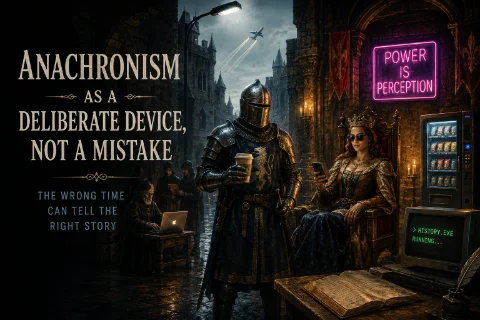
A knight checks his reflection in a cracked elevator door.
A queen speaks like a modern politician.
A medieval village has neon signs.
A Roman soldier listens to jazz in a dream.
At first glance, these details look wrong. They seem misplaced, inaccurate, or careless. A thing from one time has appeared in another. That is an anachronism.
But not every anachronism is a mistake.
Sometimes, the wrong object in the wrong century is exactly what the story needs.
In creative writing, anachronism can become a powerful device. It can disturb reality, sharpen satire, reveal character, create myth, bend genre, or make the past feel strangely close to the present. When used with intention, anachronism is not a broken clock in the story. It is a signal.
It tells the reader, “Time is not behaving normally here. Pay attention.”
What Is Anachronism?
An anachronism is something that belongs to one time period but appears in another.
In a historical novel, a character using a smartphone in the 1700s would be an obvious anachronism. A Victorian character speaking in twenty-first century slang could also be one. A medieval king wearing a wristwatch would stand out immediately.
In ordinary writing, anachronisms are often treated as errors. They can break immersion if the writer did not intend them.
But deliberate anachronism is different.
A deliberate anachronism is a conscious artistic choice. The writer knows the detail does not belong. That is the point.
The misplaced object, phrase, behavior, or idea creates meaning because it does not fit.
Why Writers Use Anachronism on Purpose
Writers use deliberate anachronism because time is not only a setting. Time is a tool.
A story can obey time strictly, or it can bend time to reveal something deeper. Sometimes accuracy is not the highest goal. Sometimes emotional truth, symbolic force, or thematic tension matters more.
A deliberate anachronism can show that history is repeating itself. It can make an old conflict feel current. It can turn a serious story strange. It can create humor. It can expose power, vanity, violence, or hypocrisy across centuries.
For example, a king delivering speeches like a modern celebrity may reveal that fame and authority have always been performances.
A Greek goddess wearing sunglasses may show that myth is not dead. It has simply changed costume.
A samurai walking through a train station may suggest that the past still moves inside the present.
The anachronism creates a bridge between eras.
The Difference Between Mistake and Device
The difference between an accidental anachronism and a deliberate one is control.
A mistake usually feels random. It appears once, breaks the world, and offers no deeper meaning.
A device feels patterned. It belongs to the story’s language. It serves tone, theme, character, or structure.
If a historical novel accidentally mentions a plastic bottle in a medieval castle, the reader may lose trust. But if the entire novel blends medieval politics with modern corporate language, the reader understands that the mismatch is intentional.
The question is not, “Is this historically accurate?”
The better question is, “Does this wrongness create meaning?”
If the answer is yes, the anachronism may be working.
Anachronism as Symbol
A deliberate anachronism can function like a symbol.
Imagine a story set in an ancient empire where the emperor wears a digital watch. The watch does not belong there, but it may symbolize obsession with control, measurement, conquest, or mortality.
The object becomes more than a mistake in time. It becomes an image.
A typewriter in a futuristic spaceship may represent memory, slowness, or resistance to digital life.
A neon sign in a ruined kingdom may represent desire surviving after civilization collapses.
A modern mirror in a mythic palace may represent self-awareness entering an old legend.
Anachronism works beautifully when the misplaced thing carries emotional or thematic weight.
Anachronism in Historical Fiction
Historical fiction usually depends on believable detail. Readers expect the world to feel rooted in its time. Because of that, anachronism must be used carefully.
A deliberate anachronism in historical fiction should not feel like laziness. It should feel like interpretation.
A writer may use modern language in an old setting to make characters feel immediate and alive. A writer may use contemporary references in a historical retelling to expose similarities between past and present. A writer may blend time periods to show that history is not distant, but ongoing.
The danger is that readers may mistake deliberate choice for poor research.
That is why consistency matters.
If the story is mostly realistic, one random anachronism will feel like an error. But if the story establishes from the beginning that it is stylized, theatrical, dreamlike, satirical, or mythic, the reader is more likely to accept the time bending.
The writer must teach the reader how to read the world.
Anachronism in Fantasy and Myth
Fantasy gives anachronism more freedom.
A fantasy world does not need to copy one real historical period. It may contain castles, airships, ancient gods, clockwork machines, internet-like magic, handwritten prophecies, and futuristic weapons. These elements can coexist if the world has its own logic.
In fantasy, anachronism can make the world feel original.
A kingdom with medieval clothing and advanced astronomy may feel rich and layered.
A mythic warrior carrying a mechanical heart may suggest a civilization where magic and machinery grew together.
A fairy court using legal contracts like a modern corporation may create satire and tension.
The key is internal consistency. The elements do not need to belong to the same real-world century. They need to belong to the same fictional reality.
Anachronism as Satire
Anachronism is especially powerful in satire.
By placing modern habits into old settings, writers can expose how little human behavior has changed.
A Roman senator giving a press conference.
A medieval court obsessed with public image.
Ancient warriors negotiating sponsorship deals.
A royal family managing rumors like a social media crisis.
These mismatches can be funny, but they can also be sharp. Satirical anachronism shows that power often wears different clothes while repeating the same patterns.
The past becomes a mirror for the present.
The reader laughs first, then recognizes something uncomfortable.
Anachronism as Emotional Truth
Sometimes anachronism is not about humor or shock. It is about emotion.
A character in the past may speak in a modern voice because the writer wants the reader to feel close to them. A dead queen may sound like a contemporary woman because her loneliness, ambition, or fear is not ancient. It is human.
Strict historical language can create distance. Deliberate modern phrasing can remove that distance.
Of course, this must be handled carefully. If every character sounds casually modern, the historical setting may lose texture. But when done with rhythm and intention, modern language can make old pain feel immediate.
The emotional truth becomes more important than surface accuracy.
A woman in 1500 and a woman in 2026 may not use the same words, but heartbreak, hunger, shame, courage, and desire can cross time.
Anachronism can help the reader feel that crossing.
Anachronism and Dream Logic
Some stories use anachronism to create dream logic.
In dreams, time periods mix without explanation. A childhood home may contain a future city. A dead relative may wear clothes they never owned. A school hallway may lead into an ancient temple.
This kind of anachronism tells the reader that the story is working through memory, trauma, prophecy, or the unconscious mind.
A dreamlike anachronism does not need to be explained logically. Its power comes from emotional association.
For example:
A soldier from a forgotten war stands under a modern streetlight.
A child in an old photograph is holding a phone that has not been invented yet.
A dead mother appears in a supermarket aisle wearing a dress from another century.
These images feel wrong, but the wrongness creates unease. It suggests that time has folded.
Anachronism and Character
A misplaced object or behavior can reveal character.
A princess in an ancient kingdom who uses modern ideas of freedom may feel like a person born before her time.
A scientist in the future who writes letters with ink may be resisting the world they live in.
A ghost who speaks in slang from many centuries may show that death has made time meaningless.
A villain surrounded by objects from different eras may appear greedy, immortal, or detached from ordinary human life.
Anachronism can show that a character does not fully belong to their world.
They may be ahead of their time, trapped by the past, haunted by the future, or living outside time altogether.
How to Use Anachronism Well
1. Know the Rule Before You Break It
Research matters. Even when you break historical accuracy, you should understand what you are breaking. Intentional distortion is stronger than accidental confusion.
2. Make the Anachronism Serve the Story
Do not include a misplaced object only because it looks interesting. Ask what it adds to theme, mood, plot, or character.
3. Be Consistent With Tone
A serious realistic novel cannot absorb random comic anachronisms easily. A stylized or surreal novel can. Match the device to the story’s atmosphere.
4. Introduce the Pattern Early
If time will be flexible, let the reader sense that early. A first-page anachronism can teach the reader that this world follows unusual rules.
5. Avoid Confusing the Reader Without Purpose
Mystery is useful. Confusion is not always useful. The reader should feel that the mismatch means something, even if they do not understand it immediately.
6. Use Contrast
The power of anachronism comes from contrast. Let the reader feel the collision between eras.
7. Trust the Image
A single strong image can do more than a long explanation. A knight under fluorescent light. A prophet with a microphone. A castle with a security camera. Let the image speak.
Example: Accidental vs Deliberate Anachronism
Accidental version:
“The medieval guard checked his wristwatch and opened the castle gate.”
This feels like a mistake because nothing in the sentence suggests purpose.
Deliberate version:
“The king had banned clocks, yet every guard wore a wristwatch under his chainmail. No one spoke of time in the palace, but everyone obeyed it.”
Here, the anachronism has meaning. The wristwatch suggests control, secrecy, and contradiction. It creates a world where time itself may be political.
That is the difference.
When Anachronism Fails
Anachronism fails when it feels careless.
It can fail when the writer uses modern language in a historical setting without rhythm or purpose. It can fail when objects appear without explanation in an otherwise realistic world. It can fail when the mismatch is funny in a scene that needs emotional seriousness.
It can also fail when the writer uses anachronism to avoid research.
Deliberate anachronism is not an excuse to know less. It is a reason to choose more carefully.
The writer should be able to answer:
Why is this here?
What does it change?
What would be lost if it were removed?
If there is no answer, the anachronism may not be doing enough work.
The Beauty of the Wrong Detail
A deliberate anachronism can make a story unforgettable because it creates friction.
It interrupts the expected.
It asks the reader to look twice.
It makes time visible.
When a detail does not belong, it can reveal the hidden structure of the story. It can show that history is not clean, that memory is not accurate, that myth is still alive, that the past and present are constantly speaking to each other.
The wrong detail can become the right wound.
It can become the crack where meaning enters.
Time as a Storytelling Material
Writers are not only builders of plot. They are also builders of time.
A story can move forward in a straight line, but it does not have to. It can fold, echo, collide, distort, and misbehave. Anachronism is one way to make time unstable on purpose.
Used carelessly, it becomes a mistake.
Used deliberately, it becomes a device.
It can make the past feel present. It can make the present feel ancient. It can reveal character, sharpen satire, deepen symbolism, and turn a familiar world strange.
Sometimes the thing that does not belong is the thing that tells the truth.
Sometimes the clock in the wrong century is not wrong at all.
It is the story asking us to notice time.