Introduction: When the Sentence Cannot Finish Itself
A character begins to speak.
Then stops.
Changes direction.
Forgets the point.
Returns to something else.
The sentence breaks because the mind has broken its path.
This is anacoluthon.
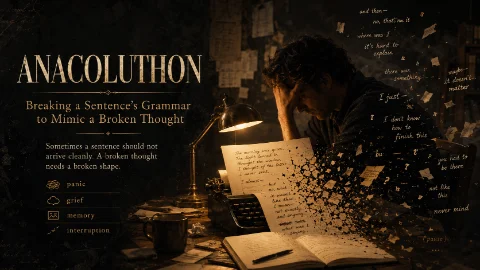
Anacoluthon is a rhetorical and literary device where a sentence begins with one grammatical structure but suddenly shifts into another. The result may look unfinished, interrupted, awkward, or fractured. But when used deliberately, it can feel deeply human.
People do not always think in perfect grammar.
Fear interrupts grammar.
Grief interrupts grammar.
Love interrupts grammar.
Shock interrupts grammar.
A clean sentence can describe a broken thought, but a broken sentence can become the thought itself.
That is the power of anacoluthon in creative writing.
What Is Anacoluthon?
Anacoluthon happens when the grammar of a sentence does not follow the path it first promises.
A sentence begins one way, then swerves.
For example:
“If I had known, if anyone had told me, the door was already open.”
The sentence does not complete its original structure neatly. It begins with a conditional thought, then collapses into an image.
In formal writing, this might be considered incorrect.
In fiction, poetry, dialogue, inner monologue, and dramatic narration, it can be beautiful.
Anacoluthon creates the feeling of thought in motion.
Not thought after it has been edited.
Thought as it happens.
Why Broken Grammar Can Feel More Real
Perfect grammar often feels controlled.
But strong emotion is not always controlled.
When a character is calm, they may speak in complete sentences. When they are frightened, ashamed, overwhelmed, or remembering something painful, their language may fracture.
They may start one idea and abandon it.
They may repeat themselves.
They may leap ahead.
They may leave words unsaid.
They may speak as if the body knows the truth before the sentence does.
Anacoluthon captures this instability.
It lets the reader feel the character’s mind struggling to organize experience.
The Difference Between Mistake and Device
Anacoluthon can easily look like a grammar error.
The difference is intention.
A mistake weakens clarity without adding meaning.
A device breaks grammar to create emotional or psychological effect.
If a sentence is broken because the writer does not understand structure, the reader may feel confusion.
If a sentence is broken because the character is afraid, stunned, or unable to speak directly, the reader feels meaning.
The brokenness must serve the moment.
The grammar should crack where the emotion cracks.
Anacoluthon in Dialogue
Dialogue is one of the best places to use anacoluthon because real speech is rarely perfect.
People interrupt themselves constantly.
They begin with one thought, then shift.
They avoid saying what they mean.
They correct themselves.
They trail off.
For example:
“I was going to tell you, but then you looked at me like that and I thought, no, not now, not while your mother was still in the house.”
The sentence moves through hesitation, fear, timing, and emotional pressure.
It does not behave like polished prose.
It behaves like speech under strain.
Anacoluthon in Inner Monologue
Anacoluthon is also powerful in inner monologue.
The inside of a mind is not always linear. Thoughts arrive in fragments, collisions, unfinished phrases, memories, fears, and sudden images.
A character may think:
“She should call him. No. Not call. Not after the letter. Not after what he said about the garden.”
This is not a traditionally complete sentence pattern, but it feels like a mind trying to protect itself from pain.
Inner monologue can use broken syntax to reveal what a character cannot calmly explain.
Panic and the Fractured Sentence
Panic changes language.
A character in danger may not think in elegant sentences.
They may think in flashes.
The lock.
The window.
The footsteps.
Too close.
Not enough time.
Anacoluthon can imitate the speed of fear. It allows prose to become breathless, broken, urgent.
For example:
“He had to get out, the stairs, no, the hall was blocked, the smoke was already under the door.”
The sentence rushes forward without formal balance.
That imbalance creates danger.
The reader feels the mind moving faster than grammar can hold.
Grief and the Sentence That Cannot Continue
Grief often resists completion.
A grieving character may be unable to finish a thought because finishing it would make the loss real.
For example:
“She kept his coat by the door because when he came home, if he came home, no, she knew, she knew.”
The sentence breaks because the character cannot fully enter the truth.
This is where anacoluthon becomes more than style. It becomes emotional structure.
The sentence performs denial.
Shame and Avoidance
Anacoluthon can also reveal shame.
A character may begin to confess, then retreat.
They may talk around the truth.
They may change direction before naming the wound.
For example:
“I only went there because she asked, because someone had to, and the money, I did not know about the money then.”
The grammar stumbles around the hidden guilt.
The reader senses evasion.
The sentence becomes evidence.
Memory and Broken Time
Memory rarely arrives in order.
One smell can bring back a room.
One word can open a childhood scene.
One sound can interrupt the present.
Anacoluthon can imitate the disorder of memory.
For example:
“The kitchen smelled of cardamom, and suddenly she was seven again, the green bowl, her father laughing, before the hospital, before all that.”
The sentence begins in the present, then folds into memory.
Grammar bends because time bends.
The Beauty of Incompletion
Not every sentence needs to close like a locked door.
Some sentences should remain open.
Some thoughts are too fragile to finish.
Some truths become stronger when left partly unsaid.
Anacoluthon can create that sense of incompletion.
A character may say:
“If you had stayed, I think maybe we could have, but it does not matter now.”
The unfinished thought contains the heartbreak.
The reader understands what the character cannot say.
Sometimes the missing grammar carries the emotion.
How to Use Anacoluthon Well
1. Break Grammar for a Reason
Do not fracture sentences randomly. Tie the break to emotion, pressure, memory, fear, shock, or voice.
2. Keep the Meaning Reachable
The reader can feel disorientation, but they should not become completely lost.
3. Use It Sparingly
If every sentence is broken, the effect weakens. Anacoluthon works best when placed at moments of emotional intensity.
4. Match the Character
Some characters speak neatly even under stress. Others fracture quickly. Let the device fit the person.
5. Use Rhythm
Broken grammar still needs music. Read the sentence aloud to hear whether the fracture feels alive.
6. Let Silence Complete the Thought
Sometimes what is not finished is what the reader remembers.
7. Do Not Confuse Messy With Powerful
A broken sentence must still be crafted. Disorder on the page should feel emotionally precise.
Example: Clean Sentence vs Anacoluthon
Clean version:
“She wanted to apologize, but she could not find the words.”
Anacoluthon version:
“She wanted to say sorry, but the word, when she reached for it, it had teeth.”
The second version breaks expectation. The grammar swerves. The sentence itself becomes uneasy.
That uneasiness reveals the emotional truth.
When Anacoluthon Fails
Anacoluthon fails when it feels accidental.
It can also fail when the break is too confusing, too frequent, or too decorative.
Readers may forgive fractured grammar if they feel emotional purpose behind it. They may not forgive it if it appears to be carelessness.
The writer must remain in control even when the sentence looks uncontrolled.
That is the paradox.
The thought may be broken.
The craft must not be.
The Grammar of a Troubled Mind
Anacoluthon reminds writers that language is not only a tool for clarity.
It is also a tool for pressure.
A sentence can hesitate.
It can panic.
It can hide.
It can collapse.
It can change direction because the character cannot bear the original path.
When used well, anacoluthon makes prose feel immediate and human. It lets the reader experience thought before it has been cleaned, arranged, and explained.
Because sometimes the most honest sentence is not the perfect one.
Sometimes the broken sentence is the only shape the truth can take.