Introduction: The Small Mirror Inside the Story
Some stories hide their whole meaning in one small place.
A child builds a paper house that collapses before the family home is lost.
A woman sees a cracked portrait before her marriage begins to fracture.
A king watches a puppet play about a greedy ruler before his own kingdom falls.
A writer reads a story about a man who cannot finish his book.
At first, the scene may look decorative. A symbol. A mood piece. A strange detail. But later, the reader realizes that the scene was not small at all.
It was the entire story in miniature.
This is the power of mise en abyme.
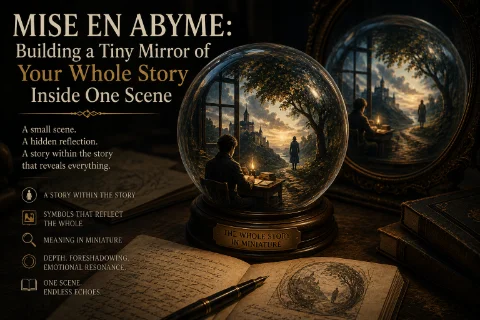
Mise en abyme is a storytelling technique where a smaller element inside the story reflects the larger story around it. It is a mirror placed within the narrative. A scene inside the story quietly repeats, compresses, or reveals the shape of the whole.
It is one of the most elegant and advanced tools in creative writing because it allows a writer to hide the soul of a novel inside a single moment.
What Is Mise en Abyme?
Mise en abyme is a French term often used in art and literature. In simple creative writing terms, it means placing a small version of the larger work inside the work itself.
It can appear as:
A painting inside a novel.
A play inside a play.
A story told by one character that reflects the main plot.
A dream that echoes the emotional arc.
A game that mirrors the conflict.
A photograph that captures the central wound.
A miniature model of a house that resembles the family structure.
A myth or folktale that predicts the story’s ending.
The smaller element does not need to explain the whole story directly. In fact, it often works best when it feels natural, mysterious, or symbolic. The reader may not understand it at first. Later, its meaning deepens.
A good mise en abyme is not a lecture.
It is a tiny mirror.
Why Writers Use Mise en Abyme
Writers use mise en abyme because it creates depth.
A story becomes richer when one part reflects the whole. The reader feels that the narrative has hidden architecture. Everything seems more connected, more intentional, more alive.
This technique can do several things at once.
It can foreshadow the ending.
It can reveal the theme.
It can expose a character’s inner state.
It can create irony.
It can make the story feel mythic.
It can turn an ordinary object into a secret map.
The beauty of mise en abyme is that it lets meaning appear indirectly. Instead of telling readers what the story is about, the writer gives them a small scene that behaves like the larger story.
The reader discovers the connection.
That discovery creates pleasure.
The Mirror Scene
One of the clearest ways to use mise en abyme is through a mirror scene.
This is a scene that reflects the entire story’s central conflict on a smaller scale.
For example, imagine a novel about two brothers fighting over inheritance, memory, and family loyalty. Early in the story, they play chess as children. One brother knocks over the king rather than lose. The other silently resets the board.
That childhood scene may contain the whole book.
Power.
Pride.
Cheating.
Resentment.
Silence.
The refusal to lose.
The attempt to restore order.
The scene is small, but it holds the larger emotional pattern.
A mirror scene works because it gives readers a quiet preview of the story’s deepest logic.
The Object That Contains the Whole Story
Mise en abyme can also live inside an object.
A dollhouse in a family drama.
A cracked mirror in a psychological novel.
A map in an adventure story.
A music box in a ghost story.
A birdcage in a story about control.
A locked diary in a story about hidden truth.
The object becomes more than a prop. It becomes a compressed version of the whole narrative.
For example, in a novel about a mother who controls every part of her daughter’s life, the daughter may keep a tiny glass bird in a box. The bird is beautiful, preserved, and trapped. The object quietly mirrors the daughter’s condition.
The writer does not need to say, “She felt like the bird.”
The reader understands.
That is the strength of the technique.
A Story Inside the Story
Another powerful form of mise en abyme is the story within the story.
A character tells a legend.
A child hears a bedtime tale.
A prisoner writes a fable.
A grandmother repeats an old village story.
A traveler describes something that happened long ago.
At first, this inner story may seem separate. But slowly, the reader realizes that it reflects the main narrative.
A folktale about a girl who feeds a wolf may mirror a protagonist who keeps trusting dangerous people.
A myth about a city swallowed by the sea may mirror a family destroyed by secrets.
A bedtime story about a lost prince may mirror a child’s search for identity.
The inner story becomes a symbolic blueprint.
It allows the writer to speak about the main story from a slight distance.
The Play Within the Play
A classic mise en abyme structure is the performance inside the narrative.
A play, film, puppet show, ceremony, ritual, trial, song, or public speech can become a smaller version of the larger story.
This is powerful because performance already contains reflection. Characters watch a staged version of themes they may not yet understand.
A corrupt ruler watches a play about justice.
A liar watches a puppet show about a boy whose shadow betrays him.
A family attends a wedding where the vows sound like accusations.
A singer performs a song about leaving while secretly planning to disappear.
The performance becomes a mirror the characters may refuse to look into.
Readers, however, see the connection.
That creates dramatic irony.
The Dream as a Tiny Story
Dreams are often misused in fiction, but they can be excellent vehicles for mise en abyme when handled carefully.
A dream should not simply be strange. It should compress the emotional truth of the story.
A character dreams of walking through a house where every room contains a younger version of themselves. This could mirror a novel about memory and self-forgiveness.
A queen dreams of wearing a crown made of ice. This could mirror a story about power that slowly destroys warmth.
A man dreams of trying to cross a bridge that rebuilds itself behind him and collapses ahead of him. This could mirror a story about being trapped between past and future.
The dream does not need to predict events literally. It can reflect the emotional structure.
A strong dream scene should feel like the story speaking in symbols.
How Mise en Abyme Creates Foreshadowing
Mise en abyme can work as subtle foreshadowing.
The small mirror shows the story before the story fully happens.
A child’s toy ship sinks in a basin before the family business fails.
A painting of a woman with no face appears before the protagonist loses her identity.
A garden maze is shown before the plot becomes a maze of lies.
A candle burns through a letter before a secret destroys a relationship.
This kind of foreshadowing is not blunt. It does not announce the future directly. It creates an emotional pattern.
Later, when the larger event happens, the reader feels a deep echo.
They may not remember the small scene consciously, but they feel its shadow.
How Mise en Abyme Reveals Theme
Theme can be difficult to write because direct explanation often feels heavy.
Mise en abyme lets the writer reveal theme through miniature action.
If your story is about freedom, show a caged animal.
If your story is about inheritance, show a child trying on an adult coat.
If your story is about identity, show a portrait that keeps being repainted.
If your story is about guilt, show a stain no one can remove.
If your story is about memory, show a broken recording that repeats one sentence.
The small image carries the theme without turning the story into an essay.
Readers feel the meaning before they analyze it.
The Emotional Echo
A good mise en abyme does not only mirror plot.
It mirrors emotion.
A scene may contain the same emotional movement as the whole story.
For example, a novel may follow a woman who spends years trying to repair a broken relationship before finally letting it go. Early in the novel, she may spend an afternoon trying to mend a torn dress. Every stitch pulls another thread loose. At last, she folds the dress and places it in a drawer.
That small scene mirrors the emotional arc.
Effort.
Frustration.
Recognition.
Release.
The dress is not the relationship, but it carries the same emotional rhythm.
That is mise en abyme at its most human.
The Danger of Being Too Obvious
Mise en abyme can fail when the mirror is too clear.
If the smaller scene copies the larger story too directly, readers may feel manipulated. The technique becomes heavy-handed.
A subtle mirror is usually stronger.
Instead of making a character watch a play that exactly repeats the plot, create a partial reflection. Let the smaller element share the emotional pattern, not every detail.
The mirror should be slightly distorted.
Readers should sense the connection before they can fully explain it.
That delay is part of the pleasure.
The Danger of Being Too Hidden
The opposite problem is making the mirror too obscure.
If the small scene has no visible connection to the larger story, readers may not feel its importance.
Mise en abyme works best when the connection is discoverable. It does not need to be obvious, but it should reward attention.
A reader should be able to return after finishing the story and say, “Now I understand why that scene mattered.”
That feeling of delayed recognition is one of the technique’s greatest strengths.
How to Build a Mise en Abyme Scene
1. Find the Heart of Your Story
Ask what your story is truly about. Not the plot summary, but the inner pattern.
Is it about betrayal?
Loss of innocence?
The cost of power?
A family repeating its wounds?
A character escaping a false identity?
2. Shrink That Pattern
Create a small scene, object, story, or image that contains the same pattern in miniature.
A whole war can become a broken chessboard.
A failing marriage can become a dying houseplant.
A family curse can become a lullaby.
3. Make It Natural
The mirror should belong to the scene. It should not feel inserted only for symbolism.
4. Let It Change Later
The meaning of the small scene should deepen as the story progresses.
5. Avoid Explaining It Too Much
Trust the reader to recognize the echo.
6. Use Sensory Detail
The more concrete the miniature is, the more powerful it becomes.
7. Let It Reflect, Not Replace
The tiny mirror should enrich the story, not become a distracting puzzle.
Example: Ordinary Scene vs Mise en Abyme Scene
Ordinary version:
“Leah waited for her father to come home. He did not arrive.”
Mise en abyme version:
“While Leah waited, she built a house from matchboxes on the kitchen table. She gave it a door, two windows, and a roof that leaned to one side. When the clock struck ten, the roof collapsed. She did not rebuild it.”
The second version contains the emotional pattern of the larger story.
Waiting.
Home.
Fragility.
Collapse.
Refusal to repair.
The father’s absence is still there, but now the scene has a miniature mirror. The matchbox house quietly holds the whole wound.
When to Use Mise en Abyme
Use this technique when you want a story to feel layered, symbolic, or carefully structured.
It is especially useful in:
Literary fiction.
Gothic fiction.
Psychological fiction.
Fantasy.
Historical fiction.
Mystery.
Family drama.
Metafiction.
Mythic retellings.
Stories about art, memory, identity, power, grief, or fate.
Mise en abyme works best when your story has a strong central pattern. The clearer you are about the deeper shape of the story, the better you can mirror it in miniature.
Final Thoughts: The Story Hidden in the Smallest Place
A great story does not always reveal itself through the largest event.
Sometimes it hides inside a toy, a painting, a dream, a song, a game, a ritual, a story told beside a fire, or one strange moment that seems too small to matter.
Mise en abyme is the art of placing the whole inside the part.
It gives the reader a mirror inside the narrative. At first, they see only a scene. Later, they see the structure of the entire story reflected back.
This technique rewards attention. It makes fiction feel designed without feeling mechanical. It turns small details into secret architecture.
The whole novel may be a storm.
But somewhere inside it, there is a glass of water trembling on a table.
And if the writer has done the work well, that tiny trembling glass contains the storm.