Introduction: The Distance Between Two People
A woman reaches for a book.
A man reaches for the same book.
Their hands stop inches apart.
Nothing is said.
Nothing happens.
Yet the room suddenly feels different.
Readers lean forward.
Why?
Because attraction often appears in space before it appears in words.
Many writers focus on thoughts when writing emotional tension. Characters think about each other. They analyze feelings. They wonder what the other person means. While this can be effective, some of the strongest tension in fiction emerges long before anyone understands their emotions.
It begins with proximity.
With distance.
With movement.
With the invisible geometry between bodies.
A glance across a crowded room.
A seat chosen one chair too close.
A hallway that suddenly feels too narrow.
A silence that expands or contracts depending on who enters the space.
Proximity tension is the art of making physical space carry emotional weight.
What Is Proximity Tension?
Proximity tension is the emotional energy created by the physical relationship between characters.
Not necessarily touch.
Not necessarily dialogue.
Not even necessarily romance.
Simply the awareness of where people are in relation to one another.
Humans constantly interpret space.
We notice who stands close.
Who keeps their distance.
Who moves toward us.
Who moves away.
Who enters our personal space.
Who avoids it.
Fiction can use these instincts.
A character does not need to confess attraction.
Sometimes stepping half a pace closer reveals more than an entire page of internal monologue.
Why Physical Space Matters
Readers understand space instinctively.
Long before language, human beings learned to read distance.
Distance signals safety.
Distance signals threat.
Distance signals intimacy.
Distance signals rejection.
Distance signals trust.
Distance signals uncertainty.
When writers manipulate space, they engage something ancient in the reader's mind.
The body understands before the intellect does.
That is why proximity tension often feels immediate.
Readers feel it before they can explain it.
Attraction Often Begins Physically
One of the biggest mistakes in romantic writing is assuming attraction begins with conscious thought.
Often it begins with attention.
Then awareness.
Then proximity.
A character starts noticing where another person is standing.
They become aware when that person enters a room.
They notice when they sit nearby.
They feel relief when they arrive.
Disappointment when they leave.
The emotional realization may come later.
The body often knows first.
Proximity tension captures that early stage beautifully.
The Gap That Holds Electricity
Space itself can become charged.
Imagine two characters sitting on opposite ends of a bench.
Nothing unusual.
Now move them closer.
A few feet apart.
Closer still.
A few inches.
Suddenly every gesture matters.
Every movement becomes visible.
The empty space between them becomes a kind of emotional object.
Readers begin measuring it.
Will it shrink?
Will it widen?
Will someone cross it?
The gap becomes a question.
Questions create tension.
Writing the Almost Touch
One of the most powerful forms of proximity tension is the almost touch.
The touch that nearly happens.
The accidental brush.
The interrupted gesture.
The shared object passed from hand to hand.
The coat offered.
The sleeve adjusted.
The hand withdrawn.
The key is restraint.
The scene becomes powerful because contact remains uncertain.
Readers feel the possibility.
Possibility often carries more energy than fulfillment.
Once the touch happens, a question is answered.
Before it happens, countless possibilities remain alive.
The Importance of Shared Space
Physical environments shape emotional tension.
A crowded elevator creates different energy than an open field.
A small car creates different tension than a public park.
A narrow hallway feels different from a ballroom.
A single candlelit table feels different from a busy restaurant.
The environment determines how characters experience one another.
When writing attraction, think about architecture.
Who can escape?
Who cannot?
How much room exists?
How visible are they?
What forces them together?
What keeps them apart?
Space itself becomes part of the scene.
Movement Creates Meaning
Proximity tension is rarely static.
Movement matters.
A character stepping closer.
A character stepping away.
A character sitting beside someone.
A character choosing not to leave.
A character lingering after a conversation ends.
These small decisions communicate enormous emotional information.
Readers notice them immediately.
A single step forward can feel more intimate than a page of dialogue.
Because movement is choice.
Choice reveals desire.
The Power of Shared Attention
Two characters do not always need to look at each other.
Sometimes the strongest tension appears when both focus on the same thing.
Watching rain.
Studying a painting.
Listening to music.
Looking out a train window.
Reading the same book.
Their attention overlaps.
The shared focus creates connection.
The characters become aware of each other's awareness.
This creates intimacy without direct confrontation.
Sometimes looking together is more revealing than looking at each other.
Silence and Physical Awareness
Silence amplifies proximity.
When people stop talking, space becomes louder.
A character notices breathing.
The scrape of fabric.
The shift of weight.
The movement of fingers.
The way light falls across someone's face.
Dialogue often distracts.
Silence reveals.
This is why many powerful attraction scenes contain pauses.
The pause creates room for physical awareness to emerge.
The reader begins noticing what the characters notice.
Proximity Without Romance
Although proximity tension is often used romantically, it can work in many forms of storytelling.
Rivalries.
Friendships.
Family relationships.
Mysteries.
Thrillers.
Political dramas.
Horror.
Any situation where emotional stakes exist can benefit from spatial tension.
A detective interviewing a suspect.
A child standing near an estranged parent.
Two enemies sharing a shelter during a storm.
A witness sitting beside a criminal.
The tension emerges from physical arrangement.
Space becomes narrative.
Writing Emotional Gravity
Some characters seem to pull others toward them.
Not physically.
Emotionally.
People drift closer.
Conversations linger.
Rooms reorganize around them.
This creates what might be called emotional gravity.
Readers begin noticing who occupies narrative space.
Who draws attention.
Who affects movement.
Who changes the atmosphere merely by arriving.
Attraction often feels like gravity before it feels like love.
Characters begin orbiting each other.
The story's geometry changes.
The Difference Between Attraction and Explanation
Many writers explain attraction.
Fewer writers demonstrate it.
Explanation says:
"She found him attractive."
Proximity tension shows:
"Without noticing, she chose the chair beside his."
The second approach creates experience.
Readers feel the attraction rather than receiving information about it.
Good tension is often physical before it becomes verbal.
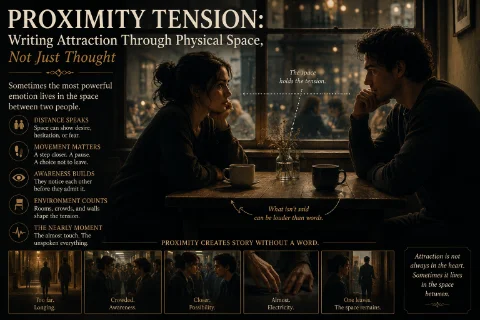
How to Write Proximity Tension
1. Track Distance
Know exactly where characters stand, sit, walk, and move.
2. Use Small Movements
Tiny shifts often matter more than dramatic actions.
3. Let Space Become Meaningful
Distance should reflect emotional states.
4. Create Obstacles
Tables, hallways, crowds, doors, and rooms can shape tension.
5. Use Silence
Silence increases awareness of physical presence.
6. Focus on Awareness
Characters notice proximity before understanding why.
7. Delay Fulfillment
The strongest tension often exists before contact.
Example: Thought vs Proximity
Thought-based version:
"Emma couldn't stop thinking about Daniel."
Proximity-based version:
"Every time Daniel entered a room, Emma became aware of where the nearest empty chair was."
The second version reveals attraction indirectly.
The body reacts before the mind explains.
Readers feel the tension without being told what to think.
Common Mistakes
Overusing Internal Monologue
Too much thinking can weaken physical tension.
Ignoring Space
Characters should occupy real physical environments.
Moving Too Quickly
Tension grows through gradual changes in distance.
Explaining Every Feeling
Allow readers to interpret physical behavior.
Forgetting Environment
The room itself should influence interaction.
Why Readers Love Proximity Tension
Readers enjoy proximity tension because it feels authentic.
Real attraction rarely begins with perfect self-awareness.
It begins with attention.
Awkwardness.
Curiosity.
Awareness.
Physical presence.
The body notices before the story catches up.
Proximity tension captures that experience.
It transforms distance into drama.
A room becomes a battlefield.
A hallway becomes a confession.
A chair becomes a declaration.
A few inches become an entire chapter's worth of emotion.
The Story Hidden in the Space Between
Some of the strongest emotional moments in fiction happen before a word is spoken.
Two people stand too close.
Or not close enough.
One moves forward.
One stays.
One leaves.
One watches.
The distance changes.
Everything changes.
Proximity tension reminds writers that attraction is not only psychological. It is physical, spatial, architectural, and instinctive. It lives in movement, hesitation, awareness, and the invisible lines characters draw around themselves.
Readers do not always remember what a character thought.
They remember the moment two people stood in a doorway and neither one moved.
Sometimes the most powerful part of a story is not the characters themselves.
It is the space between them.