Introduction: When a List Becomes a Pulse
A sentence begins simply.
A room. A chair. A coat on the floor.
Then another detail arrives.
And another.
And another.
Soon the sentence is no longer just describing things. It is gathering pressure. It is building rhythm. It is carrying memory, panic, desire, grief, hunger, obsession, or wonder. The list becomes emotional. The accumulation becomes music.
This is the power of the catalogue sentence.
In creative writing, a catalogue sentence is a sentence built around a list of images, actions, objects, sensations, memories, or ideas. It can feel abundant, breathless, ritualistic, comic, mournful, overwhelming, or hypnotic. It can slow time down or make it rush forward.
A catalogue sentence is not only a way to include many details.
It is a way to make many details behave like one feeling.
What Is a Catalogue Sentence?
A catalogue sentence is a sentence that gathers a sequence of items, images, phrases, or clauses into one rhythmic movement.
It may list objects:
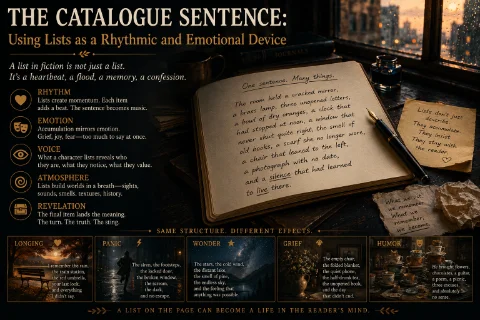
“The room held a cracked mirror, a brass lamp, three unopened letters, a bowl of dry oranges, and a clock that had stopped at noon.”
It may list actions:
“She packed the shirts, folded the photographs, emptied the drawers, closed the windows, and left the key under the blue stone.”
It may list memories:
“He remembered the rain, the hospital corridor, the smell of boiled rice, his mother’s hand on the door, the word she never finished.”
It may list fears:
“What if the car failed, the bridge flooded, the phone died, the child woke, the truth arrived too early?”
The structure is simple, but the effect can be powerful.
The list creates rhythm.
The rhythm creates emotion.
The emotion creates meaning.
Why Lists Work So Well in Fiction
Human beings think in lists more often than we realize.
We count losses.
We collect memories.
We name what we fear.
We inventory what remains.
We repeat what we cannot forget.
A catalogue sentence reflects the mind trying to organize experience. Sometimes the list feels controlled. Sometimes it feels desperate. Sometimes it becomes a way for the character to avoid the one thing they cannot say.
A list can be practical.
But in fiction, it can also be psychological.
When a character lists everything in a room, they may be avoiding grief.
When a narrator lists all the sounds in a city, they may be creating atmosphere.
When a lover lists every small thing they remember, they may be trying to keep someone alive.
The list becomes evidence of attention.
And attention is one of the deepest forms of storytelling.
The Rhythm of Accumulation
The catalogue sentence works through accumulation.
One item creates information.
Two items create pattern.
Three items create rhythm.
Four or more items create movement.
As the list grows, the reader begins to feel a pulse. The sentence gathers weight. Each new detail adds pressure to the last.
For example:
“She kept his books, his scarf, his cracked glasses, his train tickets, his matchboxes, his terrible poems, his half-empty bottle of aftershave.”
The sentence does more than tell us she misses him.
It makes us feel the shape of her keeping.
The accumulation reveals attachment.
The list becomes grief.
Catalogue Sentences and Emotional Overflow
Sometimes a list shows that a feeling is too large for one image.
Grief may need many objects.
Fear may need many possibilities.
Desire may need many small observations.
Anger may need many accusations.
Joy may need many sensory details.
A catalogue sentence allows emotion to overflow without becoming abstract.
Instead of writing:
“She was overwhelmed by memories.”
You could write:
“She remembered the kitchen tiles, the blue bowl, the burnt sugar, the wet slippers by the back door, the radio coughing through old songs, the way her father always cleared his throat before lying.”
The second version gives memory a body.
The reader does not simply understand that she remembers.
The reader enters the memory.
Lists as Character Voice
Catalogue sentences can reveal voice beautifully.
Different characters make different lists.
A practical person may list useful objects.
A romantic person may list gestures.
A guilty person may list excuses.
A fearful person may list dangers.
A grieving person may list what is missing.
A child may list colors, smells, and strange comparisons.
A detective may list evidence.
A poet may list images.
A liar may list too many details.
The way a character lists things can reveal how they see the world.
For example:
“The old man noticed the loose hinge, the damp ceiling, the unpaid bill, the cracked step, the neighbor’s silence.”
This character sees decay, responsibility, and threat.
Another character in the same house might notice:
“The yellow curtains, the smell of cumin, the sunlight on the floor, the little blue cup no one used anymore.”
Same setting.
Different list.
Different soul.
The Catalogue Sentence as Memory
Memory often arrives as fragments.
Not always in full scenes.
Sometimes memory comes as a handful of details that refuse to disappear.
A catalogue sentence can imitate that.
“She forgot the argument, but not the red umbrella, the broken sandal, the wet newspaper, the dog barking behind the gate, the way he said her name as if it had already left him.”
The list moves like memory.
It does not explain everything.
It preserves what the mind preserved.
This kind of sentence is especially useful in literary fiction, memoir-style fiction, family drama, romance, grief writing, and psychological fiction.
The catalogue becomes a memory shelf.
Each item holds a piece of the wound.
Lists That Create Atmosphere
Catalogue sentences are excellent for building atmosphere.
A gothic house can be built through a list.
A market can be made alive through a list.
A battlefield can become unbearable through a list.
A childhood neighborhood can return through a list.
For example:
“The street smelled of rainwater, frying oil, petrol, jasmine, open drains, wet newspapers, and the first smoke from evening stoves.”
The sentence does not merely describe a street.
It layers the place.
It creates density.
A good catalogue sentence can make a setting feel inhabited because real places are not made from one detail. They are made from many overlapping details.
The Breathless List
Some catalogue sentences create speed.
They rush.
They tumble.
They make the reader feel urgency.
This works well for panic, escape, excitement, obsession, or emotional collapse.
“He grabbed the passport, the money, the keys, the medicine, the photograph, the wrong coat, the right knife, and whatever courage was left in the drawer.”
The list accelerates.
The character is moving quickly.
The sentence itself seems to run.
A breathless catalogue can make prose feel physical. The reader senses the speed of thought and action.
The Slow Ritual List
Not all catalogue sentences are fast.
Some are slow, ceremonial, almost prayer-like.
They can create ritual, mourning, reverence, or intimacy.
“She washed the cup, dried the saucer, folded the cloth, swept the sugar from the table, touched the empty chair, and turned off the light.”
The list is quiet.
Each action matters.
The rhythm feels deliberate.
This kind of catalogue sentence can turn ordinary movement into emotional ritual.
A character cleaning a room can become a character saying goodbye.
The List as Denial
A list can also be a way of avoiding the truth.
A character may describe everything except the thing that matters most.
For example:
“She noticed the wallpaper peeling, the tea cooling, the fly trapped in the window, the ash on the carpet, the missing button on his sleeve, anything but the blood.”
The catalogue sentence becomes avoidance.
The reader understands that the final avoided detail has the most power.
This is one of the most effective uses of catalogue writing. The list circles the wound before naming it.
Or never names it at all.
The Comic Catalogue
Catalogue sentences are not only serious.
They can be funny.
Comedy often loves excess.
A list can grow beyond expectation until it becomes absurd.
“He brought flowers, chocolates, a handwritten apology, three legal documents, a borrowed dog, and the expression of a man who had misunderstood romance at a professional level.”
The humor comes from escalation.
Each item raises the absurdity.
A comic catalogue works best when the list moves from ordinary to unexpected. The final item often delivers the turn.
The Final Item Matters
In a catalogue sentence, the last item carries special weight.
It is where the sentence lands.
It can create surprise.
It can deepen emotion.
It can change the meaning of everything before it.
Consider:
“She packed the books, the shawls, the medicine, the silver spoons, and the photograph she had sworn she burned.”
The final item transforms the list.
Now the sentence is not just about packing.
It is about attachment, secrecy, and unfinished feeling.
The last item should often be the sharpest.
Not always the biggest.
The sharpest.
Repetition Inside a Catalogue
Repetition can strengthen a catalogue sentence.
Repeating a phrase creates rhythm and emotional pressure.
For example:
“She wanted the house before the illness, before the visitors, before the locked drawer, before the whispering, before everyone learned to smile with their mouths closed.”
The repeated “before” creates longing.
It makes the list feel like a fall backward through time.
Repetition can also create anger:
“He took the money, took the car, took the letters, took the story, took even the right to remember it differently.”
The repeated word becomes accusation.
Repetition turns a list into music.
Catalogue Sentences and Worldbuilding
In fantasy, science fiction, historical fiction, and magical realism, catalogue sentences can build worlds efficiently.
A single list can show culture, economy, ritual, technology, food, clothing, social order, and belief.
For example:
“The market sold moon-salt, copper prayers, bone flutes, fever apples, maps that changed in rain, and small jars of bottled thunder.”
The list creates a world quickly.
It also suggests tone.
A catalogue sentence lets the writer introduce many strange details without pausing to explain each one. The rhythm carries the reader forward.
The reader feels abundance before understanding every item.
That can be useful in imaginative fiction.
How to Write a Strong Catalogue Sentence
1. Know the Emotional Purpose
Do not list only to list. Decide what the sentence should create. Grief, speed, abundance, fear, comedy, memory, atmosphere, or obsession.
2. Choose Specific Details
Concrete items are stronger than vague ones. A cracked green bowl is better than an object. A railway ticket from June is better than a memory.
3. Control the Rhythm
Read the sentence aloud. A catalogue sentence should have music.
4. Build Toward the Best Item
Place the most surprising, emotional, or meaningful detail near the end.
5. Vary the Length
Short items create speed. Longer phrases create weight. Mixing them creates texture.
6. Avoid Randomness
The items should feel connected by emotion, theme, scene, or character perception.
7. Stop Before Exhaustion
A long list can be powerful, but only if the reader feels the pressure increasing. If the energy drops, end the sentence.
Example: Plain Description vs Catalogue Sentence
Plain version:
“The room was full of reminders of her childhood.”
Catalogue version:
“The room still held the cracked globe, the yellow schoolbag, the tin box of marbles, the paper stars taped to the ceiling, the cupboard that smelled of rain, and the mirror in which she had once practiced becoming someone else.”
The catalogue version is fuller.
It gives the reader objects, atmosphere, history, and emotional direction.
The final item shifts the sentence from description into character.
When Catalogue Sentences Fail
Catalogue sentences fail when they become clutter.
Too many details without emotional shape can tire the reader. A list should not feel like the writer emptying a drawer onto the page.
It can also fail when every item has the same weight.
A good catalogue sentence needs movement. It should rise, turn, deepen, or land somewhere meaningful.
If the list could be rearranged in any order and nothing changes, it may not be doing enough work.
The order matters.
The rhythm matters.
The landing matters.
The Catalogue Sentence as Emotional Architecture
A catalogue sentence is a small structure.
It has a beginning.
It gathers material.
It creates rhythm.
It lands on meaning.
It can feel like a staircase, a wave, a drumbeat, a confession, a room being opened, or a mind trying not to break.
Writers often underestimate lists because lists seem simple.
But a good list is not simple.
It is arrangement.
It is pressure.
It is attention.
It is voice.
It is timing.
A catalogue sentence can hold an entire life in one breath.
The Music of Many Things
A single image can be powerful.
But sometimes a story needs more than one.
Sometimes a feeling must arrive in pieces.
A mother’s kitchen. A dead man’s pockets. A city after rain. A child’s box of treasures. A suitcase packed in anger. A battlefield after silence. A desk covered in unfinished letters.
The catalogue sentence gives writers a way to gather these pieces and turn them into rhythm.
It teaches us that lists are not always mechanical.
They can be emotional.
They can be musical.
They can be intimate.
They can become the sound of a mind remembering, grieving, wanting, fearing, counting, preserving, or finally letting go.
In fiction, a list is never only a list when every item knows why it is there.
And sometimes the most unforgettable sentence is the one that keeps gathering until the reader feels everything the character can no longer say.