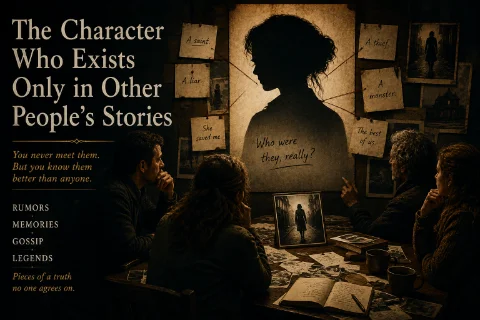
Introduction: The Person Made of Voices
Some characters do not need a scene of their own.
They do not walk into the room. They do not speak in direct dialogue. They do not perform an action while the reader watches. They may be missing, dead, distant, hidden, famous, feared, loved, or impossible to reach.
And yet, they dominate the story.
Everyone talks about them.
Everyone remembers them differently.
Everyone has a version.
To one person, they were a saint. To another, they were a liar. To one family member, they were the reason everything fell apart. To another, they were the only person who ever understood. The reader never meets them directly, but slowly begins to feel their shape through other people’s stories.
This is one of the most fascinating tools in creative writing: the character who exists only through other characters.
They are not built from action.
They are built from testimony.
What Is a Character Who Exists Only in Other People's Stories?
This type of character is someone the reader knows mainly through secondhand accounts.
They may appear through gossip, letters, interviews, memories, rumors, confessions, legends, court statements, family stories, old photographs, diary fragments, or emotional reactions from other characters.
The reader may never see the character directly in the present action of the story. Sometimes they never appear at all. But their presence is felt everywhere.
They become a puzzle made of voices.
Each person contributes one piece. Some pieces fit. Others contradict. Some are clearly biased. Some may be lies. Some may be true but incomplete.
The result is a character who feels strangely alive because no one fully owns them.
Why This Technique Is So Powerful
In real life, many people exist to us through stories.
A grandparent who died before we were born.
A founder whose name is repeated in a company.
A missing child in a town.
A famous artist no one truly knew.
A former lover everyone describes differently.
A parent whose silence shaped the family more than their presence.
We often know people through fragments. We inherit versions of them. We hear praise, warnings, accusations, myths, excuses, and memories. Over time, the person becomes larger than fact.
Fiction can use this same human pattern.
A character told by others can feel mysterious, symbolic, dangerous, beloved, or unreachable. Because the reader never fully meets them, the imagination does extra work. The blank spaces become part of the character.
Sometimes the unseen character becomes more powerful than the visible ones.
The Character as a Mirror
A character who exists through other people’s stories often reveals more about the speakers than about themselves.
When one person describes them as cruel, we learn about pain.
When another calls them generous, we learn about loyalty.
When someone refuses to speak their name, we learn about fear.
When someone exaggerates their goodness, we may sense guilt.
The absent character becomes a mirror. Every description reflects the person doing the describing.
This is why the technique is so rich. The story is not only about who the unseen character was. It is also about what others need them to be.
A dead father may become a hero because the family cannot bear the truth.
A missing woman may become a villain because the town needs someone to blame.
A vanished friend may become a legend because ordinary grief is too small for the loss.
The character changes depending on who is telling the story.
Rumor as Character Construction
Rumor is one of the strongest ways to build this kind of character.
Rumor does not care about accuracy. It cares about appetite. It grows where facts are missing. It feeds on fear, envy, curiosity, shame, and desire.
A rumored character can become almost supernatural without doing anything directly.
People may say:
She burned every letter she ever received.
He never slept in the same house twice.
No one saw her face after the wedding.
The old mayor knew where the bodies were buried.
He gave away a fortune, but no one knows why.
These claims may be true, false, or half true. The point is that they create atmosphere. They make the character feel larger than ordinary presence.
Rumor lets the writer build mystery through social imagination.
Memory as a Distorted Portrait
Memory is another powerful tool.
Unlike rumor, memory feels intimate. But memory is not pure truth. It is shaped by time, emotion, regret, longing, fear, and self-protection.
A mother may remember her son as innocent because she cannot survive any other version.
A betrayed friend may remember only the betrayal and erase every kindness.
A former lover may remember beauty more clearly than harm.
A child may remember small details and misunderstand the larger truth.
When a character exists through memory, the reader must ask what memory is protecting.
This creates emotional complexity. The unseen character becomes less like a fixed person and more like a portrait painted again and again by wounded hands.
Contradiction Makes the Character Real
If every person describes the unseen character in the same way, the character may feel flat.
Contradiction gives them life.
One person says he was gentle.
Another says he was dangerous.
One person says she left because she was selfish.
Another says she left to save someone.
One person says they were ordinary.
Another says they changed everything.
These contradictions do not weaken the character. They strengthen the sense that a full human being existed beyond the page. Real people are rarely understood the same way by everyone.
The reader begins to feel that the truth is somewhere between the versions, or perhaps beyond all of them.
That uncertainty can be more compelling than a single clear answer.
The Unseen Character as Plot Engine
This technique is not only atmospheric. It can drive the plot.
A story may revolve around discovering who this person really was.
A daughter investigates her mother’s past.
A journalist collects interviews about a vanished artist.
A town reopens an old case.
A family fights over the memory of a dead patriarch.
A young writer reads letters from someone everyone lied about.
In each case, the unseen character becomes the center of movement. They do not act in the present, but everyone else acts because of them.
Their absence creates action.
Their memory creates conflict.
Their story creates the story.
How to Write a Character Through Other People
1. Decide Why They Are Unavailable
Are they dead, missing, famous, hidden, exiled, silent, mythologized, or deliberately kept away from the reader? Their absence should have a reason.
2. Give Each Speaker a Bias
No one should describe them from a neutral place. Love, guilt, fear, jealousy, loyalty, shame, and grief all color speech.
3. Use Different Forms of Evidence
Let the character appear through conversations, objects, photographs, letters, public records, rumors, songs, or rituals.
4. Create Contradictions
Allow the accounts to disagree. The reader should feel the gap between versions.
5. Make the Character Affect the Present
Even if they are absent, they should influence choices, relationships, secrets, and conflicts.
6. Do Not Explain Everything
Leave some space. A character made entirely from other people’s stories should never feel completely captured.
7. Let the Reader Build Them
Trust the reader to assemble the person from fragments. The act of assembling creates engagement.
Example: Direct Character vs Told Character
Direct version:
“Mara was brave, secretive, and loved by the village.”
Told version:
“The baker said Mara once carried a feverish child through floodwater. The priest said she never confessed a single sin. The old women crossed themselves when her name was spoken. Her brother kept her room locked for twenty years and told everyone there was nothing inside.”
The second version does more than describe Mara. It creates mystery, conflict, admiration, fear, and emotional history. Mara becomes a character through the pressure she leaves on others.
The Danger of Making the Character Too Vague
There is a risk with this technique. If the writer gives too little, the character may feel empty rather than mysterious.
Mystery needs texture.
Give the reader specific details. A repeated phrase. A strange habit. A missing photograph. A rumor with an oddly precise object. A contradiction that hurts. A memory no one can explain.
The character should feel incomplete, but not blank.
Readers need enough fragments to believe there is a real person behind the stories.
When the Truth Does Not Matter
Sometimes the story does not need to reveal the final truth.
Maybe it is enough to show how people use the unseen character.
Maybe the family needs a saint.
Maybe the town needs a monster.
Maybe the narrator needs an excuse.
Maybe the reader understands that no final version can contain a human life.
In such stories, the question is not, “Who were they really?”
The deeper question is, “Why does everyone need a different version?”
That is where the emotional power lives.
The Character No One Can Own
A character who exists only in other people’s stories is never fully still.
They change with every voice.
They become rumor, memory, evidence, wound, myth, excuse, and inheritance. They are not present in the usual way, yet they may be the most present force in the entire narrative.
This technique reminds us that identity is not always held by the self. Sometimes it is scattered among those who loved us, feared us, misunderstood us, betrayed us, and survived us.
Some characters are written through action.
Some are written through dialogue.
Some are written through silence.
And some are written through the stories people cannot stop telling.
The most powerful character in the book may be the one the reader never meets.