The Long Grass: The story behind the murder mystery
I've been thinking about writing this particular blog post for a while now.
People occasionally ask me what inspired me to write The Long Grass, and I've always found it a difficult question to answer. Mainly because if I tell you too much about why I wrote it, I'll end up giving away some fairly important parts of the story.
So I'll have to be a little careful.
The original inspiration came from a very close friend of mine. We grew up together, went to school together and he was the best man at my wedding.
He had a pretty tough life.
He grew up in a family where alcoholism and violence were part of everyday life. His father was a violent alcoholic, and the damage that did to the family was enormous.
There were five children in that family. None of them came through it unscathed, and most have since passed away, their lives shortened in one way or another by alcoholism and addiction.
I've thought about that family a great deal over the years.
I grew up with an alcoholic parent myself. He was a man I loved and admired, and I still think of him as a great man. He spent much of his life fighting a disease that had also affected his own parent.
That intergenerational cycle of alcoholism is something I've seen far too often. The damage can carry on long after the person suffering from the disease has gone.
And sadly, it doesn't seem to be getting any less prevalent.
I wanted to write something about that. In particular, I wanted to pay tribute to my old mate and perhaps tell a story that might make people think a little about the consequences of alcoholism.
But how to go about it?
Why Weipa?
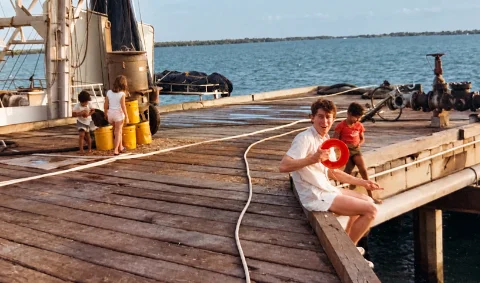
I'd spent some wonderful years living and working in Far North Queensland, particularly around Weipa and Cape York.
I loved my time up there. It's an extraordinary part of Australia, and I came away with enough stories and memories to keep me going for years.
Some of the things I witnessed were almost unbelievable. Others were confronting.
Racism and sexism were certainly prevalent, and often so casual that people barely seemed to recognise them for what they were. Coming from the city, I found some of those attitudes pretty difficult to get my head around.
I wanted to capture something of that place and time, as I remembered it.
There were also plenty of incidents from my years in the north that I thought might find their way into a novel. The gunfight at the Jabiru in The Long Grass, for example, was inspired by something that actually happened. Although I've taken a few liberties with the details, of course.
Gradually, I began to see how I could bring these different experiences together into a story.
And somewhere along the way, three dead men ended up in the long grass near Stubby Beach.
The story I wanted to tell
I won't say too much about what happens in the book because I don't want to spoil it for anyone who hasn't read it.
But there's a reason the novel takes the direction it does in Part Two.
That part of the story was always at the heart of what I wanted to write, long before I had worked out who was going to murder whom.
Whether I've managed to do justice to the subject is something readers will have to decide for themselves.
I hope I have.
And then there's Annette Mollison.
I invented Annette as one of the detectives investigating the murders and, somewhere along the way, became rather fond of her.
Apparently, I wasn't quite ready to say goodbye to her when I finished The Long Grass, because I'm now well into writing her second investigation, Gone for Now.
I've even got a couple more stories in mind for her.
Which is interesting, because when I first sat down to write The Long Grass, I had absolutely no intention of creating a series.
Then again, a few years ago I had absolutely no intention of becoming a novelist either.