Imagine reading these two sentences:
- I wanted to go outside.
- It was raining.
Both sentences make sense on their own, but they feel disconnected.
Now read:
"I wanted to go outside, but it was raining."
The word but connects the two ideas and shows a relationship between them.
Words like but are called conjunctions.
Conjunctions are important because they help us join words, phrases, and sentences smoothly, making our communication clearer and more natural.
What Is a Conjunction?
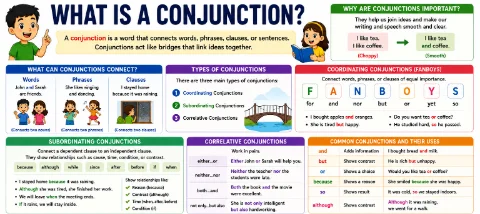
A conjunction is a word that connects words, phrases, clauses, or sentences.
Think of conjunctions as bridges that link ideas together.
Examples:
- and
- but
- or
- because
- although
- while
- so
Why Are Conjunctions Important?
Without conjunctions, our writing would sound choppy and repetitive.
Compare:
- I like tea.
- I like coffee.
Now combine them:
- I like tea and coffee.
The conjunction and connects the two ideas into one smoother sentence.

What Can Conjunctions Connect?
Words
Example:
- John and Sarah are friends.
The conjunction and connects two nouns.
Phrases
Example:
- She likes singing and dancing.
The conjunction and connects two phrases.
Clauses
Example:
- I stayed home because it was raining.
The conjunction because connects two clauses.
Types of Conjunctions
There are three main types of conjunctions:
- Coordinating Conjunctions
- Subordinating Conjunctions
- Correlative Conjunctions
Coordinating Conjunctions
Coordinating conjunctions connect words, phrases, or clauses of equal importance.
The most common coordinating conjunctions are:
- for
- and
- nor
- but
- or
- yet
- so
These are often remembered by the acronym FANBOYS.
Examples
- I bought apples and oranges.
- She is tired but happy.
- Do you want tea or coffee?
- He studied hard, so he passed the exam.
Subordinating Conjunctions
Subordinating conjunctions connect a dependent clause to an independent clause.
They show relationships such as cause, time, condition, or contrast.
Common examples:
- because
- although
- while
- since
- after
- before
- if
- when
Examples
- I stayed home because it was raining.
- Although she was tired, she finished her work.
- We will leave when the meeting ends.
- If it rains, we will stay inside.
These conjunctions explain how one idea depends on another.
Correlative Conjunctions
Correlative conjunctions work in pairs.
Common examples:
- either...or
- neither...nor
- both...and
- not only...but also
Examples
- Either John or Sarah will help you.
- Neither the teacher nor the students were late.
- Both the book and the movie were excellent.
- She is not only intelligent but also hardworking.
Common Conjunctions and Their Uses
And
Adds information.
Example:
- I bought bread and milk.
But
Shows contrast.
Example:
- He is rich but unhappy.
Or
Shows a choice.
Example:
- Would you like tea or coffee?
Because
Shows a reason.
Example:
- She smiled because she was happy.
So
Shows a result.
Example:
- It was cold, so we stayed indoors.
Although
Shows contrast.
Example:
- Although it was raining, we went for a walk.
How to Identify a Conjunction
Ask yourself:
"Is this word connecting two ideas, words, or groups of words?"
Example:
- The dog barked and ran.
What connects the actions barked and ran?
And.
The word and is the conjunction.
Another example:
- I left early because I was tired.
What connects the two ideas?
Because.
The word because is the conjunction.
Examples of Conjunctions in Sentences
- We played football and basketball.
- She wanted to come, but she was busy.
- You can stay here or leave now.
- He passed the test because he studied.
- Although it was late, they continued working.
Conjunctions:
- and
- but
- or
- because
- although
Common Mistakes
Mistake 1
Incorrect:
"I was tired because I went to bed."
Correct:
"I was tired because I went to bed late."
Make sure the conjunction connects complete and logical ideas.
Mistake 2
Incorrect:
"I like tea and but coffee."
Correct:
"I like tea and coffee."
Use one conjunction that fits the meaning.
Mistake 3
Incorrect:
"Although it was raining. We went outside."
Correct:
"Although it was raining, we went outside."
Subordinating conjunctions usually connect clauses within the same sentence.
Practice Exercise
Identify the conjunction in each sentence.
- John and Mary are classmates.
- I stayed home because it was raining.
- She is tired but determined.
- Do you want pizza or pasta?
- Although he was nervous, he gave a great speech.
Answers:
- and
- because
- but
- or
- although
Quick Quiz
Are these words conjunctions?
- and ✔
- because ✔
- chair ✘
- although ✔
- run ✘
- but ✔
Remember, conjunctions connect words, phrases, or ideas.
Summary
A conjunction is a word that connects words, phrases, clauses, or sentences.
Examples:
- and
- but
- or
- because
- so
- although
Key points to remember:
- Conjunctions act like bridges between ideas.
- They make sentences smoother and easier to understand.
- Coordinating conjunctions connect equal ideas.
- Subordinating conjunctions connect dependent and independent clauses.
- Correlative conjunctions work in pairs.
- Common conjunctions include and, but, or, because, and so.
By mastering conjunctions, you can create longer, clearer, and more natural sentences. They are essential tools for both speaking and writing effective English.