Imagine someone says:
"The book is the table."
The sentence sounds incomplete because we do not know the relationship between the book and the table.
Now read:
- The book is on the table.
- The book is under the table.
- The book is beside the table.
The words on, under, and beside help explain the relationship between the book and the table.
These words are called prepositions.
Prepositions are small but powerful words that help us understand where, when, and how things relate to one another.
What Is a Preposition?
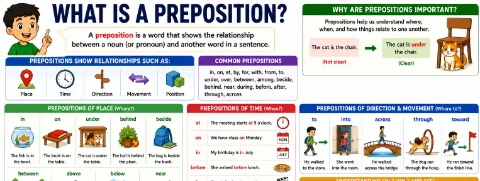
A preposition is a word that shows the relationship between a noun (or pronoun) and another word in a sentence.
Prepositions often indicate:
- Place
- Time
- Direction
- Movement
- Position
Examples:
- in
- on
- at
- under
- beside
- between
- behind
- before
- after
- during
Why Are Prepositions Important?
Without prepositions, many sentences would be confusing.
Compare:
- The cat is the chair.
- The cat is under the chair.
The second sentence clearly explains the position of the cat.
Prepositions help connect ideas and provide important details.
Prepositions of Place
These show where something is located.
Common examples:
- in
- on
- under
- behind
- beside
- between
- above
- below
- near
Examples
- The keys are on the table.
- The cat is under the bed.
- The school is near the park.
- The picture hangs above the fireplace.
- The ball rolled behind the sofa.
Question answered:
Where?
Prepositions of Time
These show when something happens.
Common examples:
- at
- on
- in
- before
- after
- during
- since
Examples
- The meeting starts at 9 o'clock.
- We have class on Monday.
- My birthday is in July.
- She arrived before lunch.
- They traveled during the summer.
Question answered:
When?
Prepositions of Direction and Movement
These show movement from one place to another.
Common examples:
- to
- into
- onto
- through
- across
- toward
- from
Examples
- She walked to the store.
- The child jumped into the pool.
- We drove across the bridge.
- The bird flew through the window.
- He ran toward the finish line.
Question answered:
Where to?
Common Prepositions
Here are some of the most frequently used prepositions in English:
- in
- on
- at
- by
- for
- with
- from
- to
- under
- over
- between
- among
- beside
- behind
- near
- during
- before
- after
- through
- across
Understanding "In," "On," and "At"
These are among the most commonly used prepositions.
In
Used for enclosed spaces or longer periods of time.
Examples:
- in the room
- in the car
- in January
- in 2026
On
Used for surfaces and specific days.
Examples:
- on the table
- on the wall
- on Monday
- on my birthday
At
Used for exact points in time or location.
Examples:
- at 8:00 AM
- at the bus stop
- at the door
- at school
Prepositional Phrases
A preposition is often followed by a noun or pronoun.
Together, they form a prepositional phrase.
Examples:
- on the table
- under the bridge
- after dinner
- during the meeting
Sentence:
"The dog slept under the table."
The phrase under the table tells us where the dog slept.

How to Identify a Preposition
Ask yourself:
Does this word show a relationship between things?
Example:
"The bag is beside the chair."
What is the relationship between the bag and the chair?
Beside.
The word beside is the preposition.
Another example:
"We met after school."
What is the relationship between the meeting and school?
After.
The word after is the preposition.
Examples of Prepositions in Sentences
- The book is on the shelf.
- She arrived at noon.
- We walked through the forest.
- The car is parked beside the building.
- They stayed in a hotel.
Prepositions:
- on
- at
- through
- beside
- in
Common Mistakes
Mistake 1
Incorrect:
"The book is in the table."
Correct:
"The book is on the table."
Choose the correct preposition based on meaning.
Mistake 2
Incorrect:
"We will meet in Monday."
Correct:
"We will meet on Monday."
Days usually use on.
Mistake 3
Incorrect:
"The train arrives on 7:00 PM."
Correct:
"The train arrives at 7:00 PM."
Specific times usually use at.
Practice Exercise
Identify the preposition in each sentence.
- The dog is under the chair.
- We met after class.
- The children ran across the field.
- She lives near the beach.
- The meeting starts at noon.
Answers:
- under
- after
- across
- near
- at
Quick Quiz
Are these words prepositions?
- under ✔
- table ✘
- beside ✔
- run ✘
- through ✔
- happy ✘
Remember, prepositions usually show relationships involving place, time, or movement.
Summary
A preposition is a word that shows the relationship between a noun or pronoun and another word in a sentence.
Examples:
- in
- on
- at
- under
- beside
- through
Key points to remember:
- Prepositions often show place, time, or direction.
- They help explain relationships between things.
- Common prepositions include in, on, at, under, and beside.
- Prepositions are often followed by nouns or pronouns.
- They make sentences clearer and more precise.
Mastering prepositions is an important step toward speaking and writing natural English. Once you understand how prepositions work, your sentences will become more accurate and easier to understand.