Imagine reading the sentence:
"The car stopped."
You know a car stopped, but you do not know anything about it.
Now read this:
"The red sports car stopped."
Suddenly, the picture becomes much clearer.
The words red and sports give us extra information about the car. These descriptive words are called adjectives.
Adjectives make writing and speaking more interesting because they help us describe people, places, animals, objects, and ideas.
What Is an Adjective?
An adjective is a word that describes or gives more information about a noun or pronoun.
Adjectives can tell us:
- What kind
- Which one
- How many
- How much
Examples:
- happy child
- blue sky
- tall building
- three books
- delicious food
In each example, the adjective provides more information about the noun.

Why Are Adjectives Important?
Without adjectives, language would be very plain.
Compare these sentences:
- I saw a dog.
- I saw a large brown dog.
The second sentence creates a much clearer image.
Adjectives help readers and listeners understand exactly what we mean.
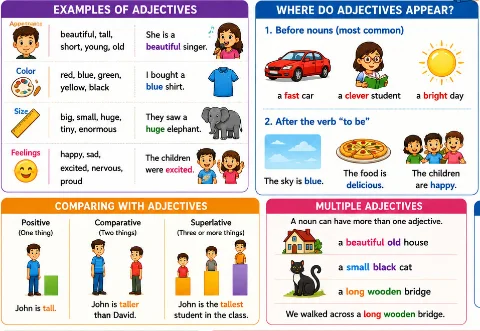
Examples of Adjectives
Here are some common adjectives:
Describing Appearance
- beautiful
- tall
- short
- young
- old
Examples:
- She is a beautiful singer.
- The tall tree touched the roof.
Describing Color
- red
- blue
- green
- yellow
- black
Examples:
- I bought a blue shirt.
- The red apple looks fresh.
Describing Size
- big
- small
- huge
- tiny
- enormous
Examples:
- We live in a small house.
- They saw a huge elephant.
Describing Feelings
- happy
- sad
- excited
- nervous
- proud
Examples:
- The children were excited.
- She felt proud of her work.
Where Do Adjectives Appear?
Adjectives usually appear before nouns.
Examples:
- a fast car
- a clever student
- a bright light
However, adjectives can also appear after certain verbs, especially forms of "to be."
Examples:
- The sky is blue.
- The food is delicious.
- The children are happy.
In these sentences, the adjectives come after the verb.
Types of Adjectives
Descriptive Adjectives
These describe qualities or characteristics.
Examples:
- brave soldier
- beautiful garden
- cold water
Quantitative Adjectives
These tell us how many or how much.
Examples:
- three books
- ten students
- several chairs
Sentences:
- I have three notebooks.
- Ten students joined the competition.
Demonstrative Adjectives
These point to specific nouns.
Examples:
- this
- that
- these
- those
Sentences:
- This book is interesting.
- Those flowers are beautiful.
Possessive Adjectives
These show ownership.
Examples:
- my
- your
- his
- her
- our
- their
Sentences:
- My bicycle is new.
- Their house is large.
Multiple Adjectives in a Sentence
A noun can have more than one adjective.
Examples:
- a beautiful old house
- a small black cat
- a long wooden bridge
Sentence:
"We walked across a long wooden bridge."
Both long and wooden describe the bridge.
Comparing with Adjectives
Adjectives can compare people, places, or things.
Positive Form
- tall
- fast
- smart
Example:
- John is tall.
Comparative Form
Used to compare two things.
Examples:
- taller
- faster
- smarter
Sentence:
- John is taller than David.
Superlative Form
Used to compare three or more things.
Examples:
- tallest
- fastest
- smartest
Sentence:
- John is the tallest student in the class.
How to Identify an Adjective
Ask yourself:
"Does this word describe a noun or pronoun?"
Example:
"The happy child laughed."
What kind of child?
Happy child.
The word happy describes the noun child, so it is an adjective.
Another example:
"I bought a red bicycle."
What kind of bicycle?
A red bicycle.
The word red is an adjective.
Common Adjective Examples
Here are some frequently used adjectives:
- good
- bad
- happy
- sad
- large
- small
- hot
- cold
- young
- old
- beautiful
- strong
- weak
- clean
- dirty
- bright
- dark
- easy
- difficult
- friendly
Common Mistakes
Mistake 1
Incorrect:
"The car red is fast."
Correct:
"The red car is fast."
Adjectives usually come before the noun.
Mistake 2
Incorrect:
"She is more taller than me."
Correct:
"She is taller than me."
Do not use both more and -er together.
Mistake 3
Incorrect:
"He is the most tallest boy."
Correct:
"He is the tallest boy."
Do not combine most with a superlative ending.
Practice Exercise
Identify the adjective in each sentence.
- The small bird sang beautifully.
- She bought a new phone.
- We visited an ancient temple.
- The children are happy.
- I saw three cars.
Answers:
- small
- new
- ancient
- happy
- three
Quick Quiz
Are these words adjectives?
- beautiful ✔
- table ✘
- happy ✔
- run ✘
- blue ✔
- elephant ✘
Remember, adjectives describe nouns or pronouns.
Summary
An adjective is a word that describes a noun or pronoun.
Examples:
- beautiful flower
- tall building
- blue sky
- happy child
Key points to remember:
- Adjectives add detail and description.
- They tell us what kind, which one, how many, or how much.
- They usually appear before nouns.
- They can compare people and things.
- They make writing more vivid and interesting.
Without adjectives, language would be plain and limited. By learning adjectives, you can make your English more descriptive, expressive, and engaging.