Writing a novel where more than one character gets to speak is one of the most exciting and demanding things a fiction writer can attempt. Done well, multiple perspective storytelling creates worlds that feel fully inhabited, truths that feel genuinely contested, and stories that linger long after the last page. Done poorly, it leaves readers confused, disconnected, and wondering which character they are supposed to care about.
This guide breaks down exactly how to do it well.
What Multiple Perspective Storytelling Actually Is (And Why It Works)
At its core, multiple perspective storytelling means giving narrative authority to more than one character. Instead of a single lens through which all events are filtered, readers experience the story through two, three, or sometimes dozens of viewpoints.
Every character knows different things, wants different things, and interprets the same events through a completely different emotional framework. That gap between perspectives is where tension, irony, and genuine complexity live. A reader who has spent a chapter inside a character's head will understand their choices with a depth that pure plot summary could never match.
Multi-POV, Alternating POV, Omniscient, Ensemble: Knowing the Difference
These terms get used interchangeably, but they describe genuinely different approaches. Choosing the right one early saves considerable structural pain later.
Multi-POV storytelling rotates through a defined set of characters, each narrating from their own first- or close-third-person perspective. George R.R. Martin's A Song of Ice and Fire series is the most-cited example, with each chapter labeled by a character name.
Alternating POV is a tighter version: usually two characters who trade off in a regular pattern. Gillian Flynn's Gone Girl runs exactly this way, Nick and Amy chapter by chapter, each telling a version of the same marriage.
Omniscient narration keeps a single narrator who can access any character's thoughts at will. The narrator, not the characters, controls emotional distance and information flow. This is not the same as multi-POV.
Ensemble cast storytelling distributes focus across a large group without giving equal chapters to each character. Minor characters get brief, vivid sections that expand the world without driving the central plot.
Choose multi-POV when each character's subjective experience is essential to meaning. Use alternating POV for intimate two-character conflicts driven by dramatic irony. Use ensemble structure when community or collective experience is the subject.
Giving Each POV Character a Completely Distinct Voice
If your characters all sound like slightly different versions of the same narrator, you have voice bleed, and readers will stop trusting your perspective shifts.
Voice is not just word choice. It is the entire way a character processes the world: what they notice first, what metaphors their thoughts reach for, what they are afraid to admit even to themselves, how their sentences run when anxious versus calm.
A few practical strategies:
Write a solo journal entry for each POV character before drafting their chapters. Let them describe the same mundane scene in their own unfiltered voice.
Define each character's blind spots. What do they consistently misread about other people? Those misreadings create natural irony when readers see the same situation from another angle.
Vary sentence rhythm intentionally. One character might think in long, circling sentences; another cuts to declarative statements. The rhythm should feel organic to their psychology.
Anchor each voice in body. A chronically anxious character might notice physical sensations constantly. A character who dissociates might describe surroundings with eerie detachment. Embodiment differentiates voices more effectively than vocabulary alone.
Structural Techniques for Weaving Perspectives
Structure is the invisible architecture of a multi-POV novel. Get it wrong and even brilliant individual chapters will feel incoherent when read in sequence.
Parallel Timelines
Two or more POV characters move through the same story period independently. Their paths may not converge until late in the novel. This works beautifully for stories where the meaning of events depends on context the reader accumulates gradually.
Convergent Plotlines
Each character has their own narrative thread, but those threads are being drawn toward a single central event or confrontation. Martin's use of this structure in A Game of Thrones is essentially architectural: the entire first novel is a set of independent trajectories accelerating toward the same collision point.
Braided Narrative Structure
This is the most technically demanding option. Three or more plotlines alternate chapter by chapter, each complete in its own right but thematically and emotionally resonant with the others. Jodi Picoult uses this structure extensively: her novels in books like My Sister's Keeper braid multiple first-person voices into a single moral argument.
In a braided structure, the chapters themselves must do double work. Each chapter serves its own character's story and also complicates or illuminates what the reader just read in the previous chapter. That interplay is what makes braided structure so satisfying when it works.
Controlling Reader Sympathy Across Multiple POVs
This is the genuinely tricky part, especially when one of your POV characters is a villain or someone whose values clash directly with the reader's.
Sympathy and approval are not the same thing. Readers can understand a character's logic and track the internal consistency of their choices without endorsing any of it. Your job is to make the character's inner life coherent, not likeable.
Flynn's Amy Dunne in Gone Girl is a masterclass in this. Amy is calculating and ultimately terrifying, but her chapters are written with such precision and bitter intelligence that readers stay inside her head even as they recoil from what she does.
To pull this off:
Give your morally grey character something they genuinely love or protect, not to redeem them, but to ground their choices in real human need.
Write the world as they actually see it. If your villain feels justified, let that justification be uncomfortably persuasive.
Control the sequence carefully. What readers know about a character before they enter that POV will shape how much empathy they extend.
The Handoff Problem: Ending One POV, Opening Another
The transition between perspective chapters is one of the most technically underestimated challenges in multi-POV writing. End a chapter badly and you bleed momentum. Open a new chapter awkwardly and readers feel like they are starting over.
Strong handoffs share a few characteristics:
End chapters on unresolved tension. If a chapter closes with everything settled, there is no reason to keep reading. End on a question, a decision unmade, a discovery that changes the stakes.
Open the next chapter in motion. Drop the new character into their immediate situation rather than starting with backstory or scene-setting. Readers orient themselves quickly when a character is already doing or thinking something specific.
Use structural echoes. The closing image of one chapter and the opening image of the next can rhyme thematically or emotionally. That echo creates a sense of intentional design and keeps the novel feeling like one coherent story.
Common Multi-POV Mistakes and How to Avoid Them
Even experienced writers run into these problems. Recognizing them early is the fastest path to fixing them.
Voice bleed: All your characters start sounding like each other. Read chapters back to back. If you could swap the character names without noticing, the voices need sharpening.
POV imbalance: One character gets far more chapters than the others, making the novel feel like it secretly has one protagonist. Audit your chapter count and your emotional investment across all POVs.
Redundant scenes: Two characters narrate the same event and neither version adds new information. Every scene must advance plot, deepen character, or reveal something the reader does not yet know. If a new POV does none of those things for a scene, cut the second version.
POV character soup: Too many POVs introduced too quickly, before readers invest in any single one. Delay some POV introductions until the reader has an emotional stake in the story world.
How Published Authors Handle This: Three Examples Worth Studying
George R.R. Martin uses chapter titles to prime readers before each shift, reducing disorientation immediately. He also gives each POV character a genuinely distinct political and personal situation, so transitions feel like channel changes rather than character replacements.
Gillian Flynn in Gone Girl engineers both narrators to be actively, deliberately unreliable. The structural pleasure comes from triangulating the truth from two self-serving accounts.
Jodi Picoult assigns each POV character a different narrative style: one lyrical, another clipped and factual. The collision of styles makes moral arguments without authorial editorializing.
Practical Exercises for Building Distinct POV Voices
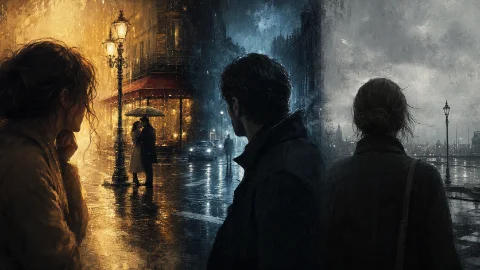
The same scene, three ways. Write a brief scene from three different character perspectives. Focus entirely on what each character notices and what they overlook.
The interview exercise. Write a first-person interview with your POV character answering questions about someone else in your novel. Their answers reveal biases, blind spots, and relationship to language.
The stress test. Write your most emotionally heightened scene twice: once with the character at their most guarded, once with them fully exposed. Use the tension between drafts to find the authentic version.
Read chapters aloud by character. If you stumble on a sentence because it does not sound like the character, revise it. The body knows before the brain does.
FAQ
How many POV characters are too many?
Most successful multi-POV novels keep the core POV count between two and five. Beyond that, you need extraordinary structural discipline. More perspectives are not automatically richer; they can dilute reader investment across the board.
Should all POV characters get equal chapter time?
Not necessarily. Chapter time should reflect narrative importance, not fairness. What matters is that every POV character gets enough time for readers to form a genuine relationship with them.
Can I switch POV mid-chapter?
Yes, but it carries risk. Head-hopping (switching POV within a scene without a clear break) tends to confuse readers. If you want to shift perspective mid-chapter, use a section break and make the transition unmistakable.
How do I keep readers from getting lost during perspective shifts?
Ground each new chapter quickly in the POV character's physical location, emotional state, and immediate situation. If readers know where they are and whose head they are in within the first paragraph, they orient themselves fast.
What is the biggest mistake writers make with multi-POV fiction?
Writing perspectives that are technically distinct but emotionally identical. Readers come to multi-POV fiction for genuinely different inner lives. If all your characters feel the same things in the same way, the structural complexity does no real narrative work.
Your Story Has More Than One Truth
The hardest thing about multiple perspective storytelling is not the structure or the voice differentiation. It is accepting that your story does not have a single authoritative version of events. Each of your POV characters believes something true about the world, and those truths are in real tension with each other.
That tension is the point. It is what makes multi-POV fiction capable of holding genuine moral and emotional complexity without resolving it into a tidy lesson.
Pick two POV characters from your current project. Write the same brief scene from both of their perspectives and pay attention to what shifts, what gets revealed that you did not expect. That exercise alone will show you what your novel is actually about.
Then start writing.