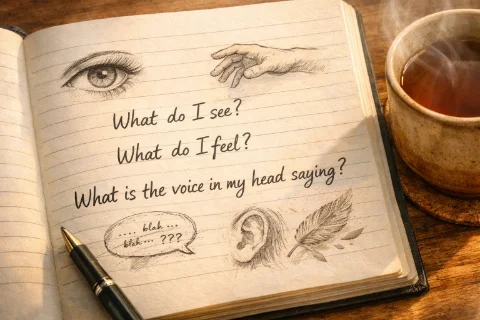
Great fiction does not just entertain. It hijacks the nervous system. Readers' hearts race, palms sweat, and eyes fill with tears over people who do not exist in places that never were. Understanding the science behind this, at the level of brain psychology and cognitive research, is one of the most powerful tools a fiction writer can develop. This is the meeting point of emotion and narrative cognition: where story structure meets the human mind, and where the most resonant fiction gets made.
What Narrative Cognition Actually Means (And Why Writers Should Care)
Narrative cognition is the way the human brain organizes experience into story form. It is not something we do only while reading novels. It is how we process memory, anticipate the future, and make sense of our own lives. Psychologist Jerome Bruner described it as one of two fundamental modes of thought: logical reasoning on one side, narrative understanding on the other.
When a reader picks up your novel, their brain does not receive it as a stream of words. It builds a mental simulation. Cognitive scientists call this a situation model: a dynamic, evolving internal representation of the story world, populated with characters, cause-and-effect relationships, and emotional stakes. Every sentence you write either enriches that model or disrupts it.
This is why scene-setting matters beyond atmosphere. When you write a cramped, cold apartment, readers are not just picturing it. They are, in a measurable sense, feeling it, because the brain's sensory systems activate in response to vivid narrative detail.
Emotion Is Not a Decoration; It Is the Engine
A common mistake among early-stage writers is treating emotion as something layered on top of plot. A character does things, and then they feel things about the things they did. That is backwards.
Emotion is the primary driver of story comprehension. Research in narrative psychology consistently shows that readers track the emotional states of characters the way they would track a friend's mood in real life, constantly updating, predicting, and responding. Without emotional stakes, plot events are just logistics.
Consider how this works in practice. If your protagonist loses a job, that event registers cognitively as a fact. But if losing that job means she will lose custody of her daughter, and you have already made the reader love that daughter, the same plot event becomes visceral. The difference is emotional architecture, and it operates at the cognitive level before the reader even consciously processes what they are feeling.
The Three Functions Emotion Serves in Story Processing
Attention allocation. Readers automatically pay more attention to emotionally charged content. The brain tags emotional scenes as significant and stores them more deeply.
Causality inference. Emotion helps readers infer why characters behave the way they do. It is the connective tissue of motivation.
Memory consolidation. Readers remember emotionally resonant scenes far longer than neutral ones. The science of embodied cognition tells us that emotional encoding is physical, not just mental.
Narrative Transportation: Why Readers Lose Themselves in Fiction
Narrative transportation theory, developed by psychologists Melanie Green and Timothy Brock, describes the state readers enter when they become fully absorbed in a story. In this state, attention narrows, real-world concerns recede, and the story world feels temporarily more real than the room the reader is sitting in.
Transportation is not a metaphor. It is a measurable psychological state with distinct cognitive and emotional markers. Highly transported readers show reduced critical thinking about story events (which is why implausible plot points are more forgivable in emotionally compelling narratives), heightened emotional response, and lasting attitude change aligned with the story's themes.
For writers, understanding transportation changes how you think about pacing. Transportation is fragile. Anything that forces readers back into their own heads, whether that is a confusing pronoun, an anachronism, or an unmotivated character choice, breaks the flow. The technical term is "denarration," but what it feels like to the reader is simply being dropped.
What Triggers Transportation
Vivid, specific sensory detail (not "the room was messy" but "three days of takeout boxes and a single unread birthday card")
Clear, emotionally legible character goals
Rising tension that creates forward-pulling narrative momentum
A protagonist whose inner life the reader can access and understand, even when disagreeing with their choices
Mirror Neurons, Empathy, and the Biology of Character Identification
In the 1990s, neuroscientists discovered a class of neurons in macaques that fired both when the animal performed an action and when it watched another animal perform that same action. Similar neural mechanisms appear to function in humans. These mirror neuron systems are part of the neurological basis for empathy.
When you read a character wincing in pain or throwing their head back in laughter, your motor and sensory cortex activates in ways that partially mirror experiencing those states yourself. This is not imagination in the loose sense of the word. It is a biological simulation.
What this means for writers is that character physicality is not cosmetic. Grounding emotion in the body, a tight throat, restless hands, the sudden stillness that comes before grief, activates reader empathy at a pre-conscious level. Readers feel before they think.
How to Write for the Mirror System
Anchor emotional states in specific, involuntary physical responses rather than named emotions ("she felt sad" vs. "she couldn't finish the sentence")
Use kinesthetic verbs that place readers in the character's body
Vary sentence rhythm to mirror emotional intensity: short sentences under pressure, longer ones in grief or wonder
Let characters' bodies contradict their words; the gap between what someone says and how they hold their shoulders is where real character lives
Advanced Techniques: Emotional Pacing, Cognitive Dissonance, and Complex Scenes
Controlling Emotional Pacing
Emotional pacing is not the same as plot pacing. A story can move quickly through events while keeping the reader emotionally suspended in a single moment, or it can slow external action to create pressure through internal experience.
Think of it as a heartbeat rhythm. Sustained high emotion produces reader fatigue. Sustained low emotion loses attention. The goal is contrast and variation: tension released into something quieter, which then rebuilds. This mirrors how the nervous system actually processes stress, which is why it feels satisfying rather than arbitrary.
Using Cognitive Dissonance in Plot
Cognitive dissonance, holding two contradictory beliefs or feelings simultaneously, is one of the most powerful states you can create in a reader. When a protagonist you love does something wrong, when a villain has a point, when the "right" choice causes harm, readers cannot look away. The discomfort itself creates investment.
This is different from moral ambiguity for its own sake. The dissonance needs to emerge from the internal logic of your story world and your characters' psychology. Planted early, paid off later.
Writing Emotionally Complex Scenes
The most resonant scenes are rarely mono-emotional. Joy shadowed by loss. Relief laced with guilt. Anger that reveals love. When a reader cannot easily name what they are feeling, the scene has achieved emotional complexity, and complex emotions create deeper memory traces.
To write these scenes:
Identify the dominant emotion, then ask what its opposite or shadow is
Let secondary characters or environmental details carry the dissonant emotional register
Resist the urge to resolve the ambiguity; let the reader sit in it
How Indie Authors Can Apply This to Write Unputdownable Fiction
Understanding the science is one thing. Here is how it translates into practical craft for indie authors working without a traditional publishing infrastructure:
Map emotional beats before plotting events. Know how you want your reader to feel at the end of each scene before you decide what happens in it.
Use the "situation model" test. After writing a scene, ask: have I given the reader enough sensory, emotional, and motivational information to build a clear mental simulation? Vague scenes fail this test.
Protect transportation in your prose. Every POV shift, every timeline jump, every abrupt tonal change is a potential ejection seat. Make each transition earn its place.
Write character bodies, not character feelings. Trust the mirror system to do its work.
Calibrate chapter endings for emotional carry-forward. End chapters not on plot cliffhangers alone but on emotional questions: readers need to know what happens, but they must know how a character will survive what they're feeling.
Earned Resonance vs. Emotional Manipulation: Knowing the Difference
There is a version of emotional writing that feels cheap: the dead dog, the sick child, the trauma backstory deployed purely for reader reaction rather than narrative necessity. Writers and readers alike often sense this manipulation, even if they cannot name it.
The difference between manipulation and earned resonance comes down to preparation and proportionality.
Earned emotion is built across the story. The reader has spent time with this character, understood their specific love for this specific person or thing, felt the weight of what is at stake. When the loss comes, it lands because the reader has been carrying that weight too.
Emotional manipulation shortcuts this preparation. It borrows emotional weight from cultural archetypes (dead children, dying animals) without doing the narrative work of building genuine attachment. It works once, often, but it does not build the kind of emotional experience that creates loyal readers.
The test: if you removed the emotionally charged event from your story, would the character and the reader still have a rich, invested relationship? If yes, your emotion is earned. If the scene is the only place the reader has been given reason to care, you are borrowing.
Write Stories the Brain Cannot Let Go
Fiction that readers cannot put down is not a matter of clever plotting or snappy dialogue alone. It is fiction that speaks the language the human brain evolved to receive: emotional, embodied, cause-and-effect story. When you understand how narrative cognition works, how transportation is created and broken, how the mirror system fires, and how emotional complexity creates lasting memory, you are not just writing better sentences. You are engineering an experience at the neurological level.
Start with one principle from this article. Map the emotional arc of your next chapter before you write a word of it. Anchor one emotional scene entirely in physical sensation. Create one moment of cognitive dissonance that makes your reader hold two truths at once.
The science is on your side. The reader's brain is waiting. Go write something it cannot forget.
FAQ: Emotion and Narrative Cognition in Creative Writing
What is narrative cognition in the context of fiction writing?
Narrative cognition is the brain's natural mode of organizing experience as story. When readers engage with fiction, their brains build active mental simulations of the story world, complete with characters' emotional states, goals, and causal chains. Writers who understand this can structure their fiction to work with that process rather than against it.
How do emotional beats differ from plot beats?
Plot beats are events: what happens in a scene. Emotional beats are the shifts in feeling those events produce in character and reader alike. A scene can have significant plot beats with weak emotional beats (flat reporting) or powerful emotional beats with minimal external action (literary fiction at its best). The most effective fiction aligns both.
What is narrative transportation and how do writers create it?
Narrative transportation is the psychological state of deep immersion, where the reader's attention narrows entirely to the story world. Writers create it through vivid sensory specificity, emotionally legible characters, clear stakes, and consistent internal logic. They protect it by avoiding anything that forces readers out: confusing timelines, inconsistent character behavior, or jarring tonal shifts.
Do mirror neurons really affect how readers respond to fiction?
The mirror neuron hypothesis in humans is still an active area of research, but the broader finding is well-supported: the brain's sensory, motor, and emotional systems activate in response to vivid narrative. Readers physically simulate what they read. Grounding emotion in bodily sensation rather than labeling it directly creates a measurably stronger reader response.
What is the difference between emotional manipulation and earned resonance?
Emotional manipulation borrows weight from cultural triggers (a dying child, a dead pet) without building genuine narrative attachment first. Earned resonance results from preparation: the reader has spent enough time with a character that when loss arrives, it carries the weight of everything before it. The test: would the reader care about this relationship even if the emotionally charged event were removed?
How can indie authors use these principles practically?
Map emotional beats before plotting events, write emotion through physical sensation rather than named feelings, protect transportation by making every POV shift earn its place, and calibrate chapter endings for emotional carry-forward, not just plot cliffhangers. These techniques do not require a traditional publishing team. They require intentional craft.