
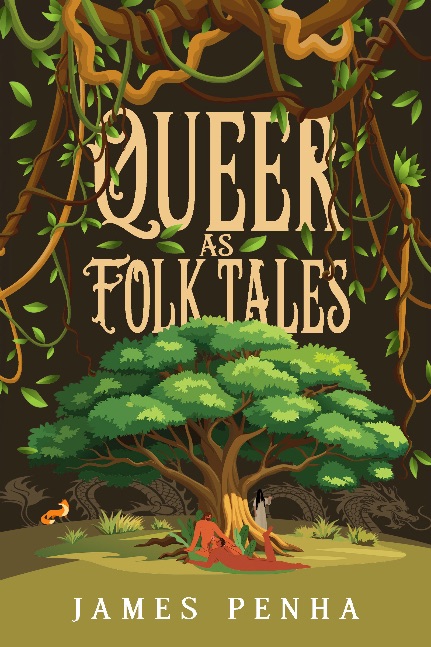
About the Book
"Why did the chicken cross the road?”
"To get to the other side."
I loved that joke and retold it for years, as did millions of children who recall it as their first and archetypal riddle. We were perfectly satisfied with its entertainment value and the limited logic that made the text work. So too with hundreds of television programs and Disney and other Hollywood films and, of course, the fairy tales and stories I devoured as a child.
Once I became, in high school and later in college and graduate school, an analyst of literature, I needed to understand character motivation and story arcs, and the objective correlative when suspension of disbelief was demanded from a text by its audience. Chicken riddles and fairy tales fell by the wayside of the road.
When I moved to Indonesia more than thirty years ago, I fell in love with its archipelago, its people, and its folk tales. Every island, every village, every tribe I visited had its legends, and they became for me souvenirs of travels in my adopted homeland. But most of the tales, especially when passed on to me orally by natives, were as fragmentary as a chicken riddle or an Aesop fable. I wanted to ask why a wizard would do this or why a goddess would choose that, but knew that the story-teller would have no way of knowing. When I did dare to be impolite enough to raise such queries, I would usually be told to "believe it or not. It's up to you."
I took on the challenge, and worked to understand characters and deities and the plots of folk tales. I rewrote them with the logic and sometimes the sensibilities and sexualities of contemporary fiction without, I hope, sacrificing the magic and fantasy and exoticism of the originals.
What I missed in the project, as a gay male, were LGBTQIA+ characters and plots. I found very few in the world of traditional folk and fairy tales, more in world mythologies. From those I did find, I set about adapting my favorites. You will find them here.
But I also dared to queer other tales—recasting apparently heterosexual characters as homosexuals—so as to focus on the struggles and heroism of gay characters absent from or closeted in the originals. These too are part of the foundation of this collection.
But only the foundation.
Living in a country where superstition and magic co-exist with reality, I have the opportunity to chronicle some pretty amazing narratives based on personal experiences. So you will also read here original stories set in our time, but crafted to complement the style of the traditional folk tales and myths with which they share this volume.
"To Get to the Other Side" is an original through-the-looking-glass kind of gay Bildungsroman. Echoing the punch line of that chicken riddle, it sets forth a pattern, followed in all these stories, of leaving the real world for a fantastic one.
Nothing follows that pattern more than the next pair of stories, “Twink Bound” and “By The Banyan Tree,” each of which focuses on people I actually met in Indonesia. I shall let each reader decide where autobiography ends and make-believe begins.
“Leaves” and “Kuntilanak” are also original stories based on beliefs and legends of Indonesia, but I don’t claim that anything in this pair of stories actually happened.
It seems appropriate to place “Between Towns,” set in Indonesia but adapted from a traditional North American folk tale, as a centerpiece before moving on to stories taking place in the rest of the world.
In "The Purloined Pearl," rooted in a simple Chinese legend, a pair of gay lovers disagree about what to do with a valuable pearl stolen from a dragon. “Year of the Rabbit" is a fictional update of the history of the queer god of Fujian province in China.
The courtship of the god Freyr and the giantess Gerda appears in Nordic mythology. I have expanded their skeletal narrative into “Frey and Gared” where Gared is a male giant for whom Frey falls. Nisus and Euryalis are the openly gay couple in The Aeneid. “In the Memory of Time” develops, even more than Virgil did, their history and their relationship.
The last two stories in the collection are freely and queerly adapted from Grimm Brothers fairy tales: “The Sensitive Sons” from “The Queen Bee” and “The Poet, His Husband, and the Fox” from “The Fisherman and His Wife.”
Whereas the book begins with a central character who comes of age and finds a new family, it concludes with a protagonist of a certain age who finds a new love.
They enclose and embrace ten other stories of queer characters in search of themselves, of love, and of peace.
Language - English
Publisher Name - Deep Desires Press
Publisher Year - 2025
ASIN - B0FR3PWYXL
ISBN-10 - 1997726157
ISBN-13 - 978-1997726159