Great fiction doesn't just happen. Behind every story that leaves readers breathless at the final page is a writer who understood plot construction at a structural level, not just a surface one. If your drafts keep collapsing halfway through, or your twists keep landing flat, this guide is for you.
Plot construction is the craft of engineering a story so that every event, character choice, and revelation connects to everything else. It's the difference between a plot that surprised you as you wrote it and a plot that surprises your reader in a way they'll remember for years.
What Plot Construction Actually Means
Most writers think of plot as the sequence of events: this happens, then this happens, then the ending. That's a start, but it misses the point.
Plot construction is about causality. Events don't just follow each other; they generate each other. A character's fear causes a bad decision. That decision causes a consequence. That consequence forces a choice that reshapes everything.
When you build a plot this way, cause and effect become the engine of your story. Readers feel the inevitability even as they're surprised by each turn. That feeling, that satisfying click of "of course it had to be this way," is the goal of every well-constructed plot.
What Is a Plot Matrix and Why Do You Need One?
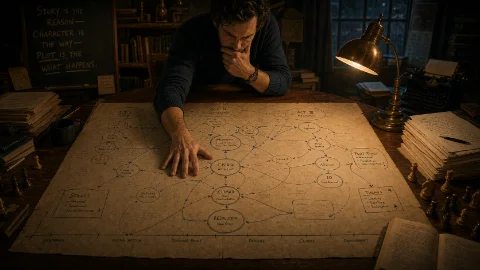
A plot matrix is a planning tool that maps the key structural elements of your story across a grid or framework. Think of it as a blueprint rather than a summary.
Where an outline lists events, a plot matrix tracks the relationships between events. It shows you which scenes carry narrative weight, where your character arcs intersect with your external plot, and whether your story's promises are actually being kept.
Why a Plot Matrix Prevents Structural Collapse
Many writers hit what's called "the murky middle." Around chapter ten or fifteen, momentum stalls, subplots drift, and the story loses shape. A plot matrix prevents this by giving you a bird's-eye view of your whole structure before you write a single chapter.
When you can see all your beats laid out visually, you spot problems early:
A twist that has no setup in Act One
A character arc that never intersects with the main plot
A climax that doesn't pay off the theme you set up in chapter two
Building a plot matrix before drafting is one of the most reliable ways to finish a novel that actually holds together.
The Four Best Plot Matrix Frameworks (And When to Use Each)
There is no single perfect framework. The best one depends on your story's shape, your genre, and how you think. Here are the four most effective options.
1. Save the Cat Beat Sheet
Blake Snyder's beat sheet breaks a story into fifteen specific beats, from the "Opening Image" to the "Final Image." It's especially useful for genre fiction, screenplays, and any story with a clear three-act shape.
The beat sheet forces you to think about why each structural moment exists. The "Dark Night of the Soul," for instance, isn't just a low point; it's the moment the protagonist loses everything they've been relying on and has to find something truer. That specificity helps you write scenes with genuine emotional function.
Best for: Commercial fiction, thriller, romance, YA, screenwriting adaptations.
2. The Story Grid
Shawn Coyne's Story Grid tracks a foolscap global story grid that maps the obligatory scenes and conventions of your genre alongside the five-part narrative arc. It also introduces "story values," the binary qualities (life/death, love/hate, freedom/slavery) that shift with each scene.
The Story Grid is particularly powerful for writers who want to understand why their story isn't working, not just that it isn't.
Best for: Literary fiction, complex genre fiction, deep revision work.
3. The W-Plot
The W-plot maps a story through five key turning points that alternate between emotional highs and lows. The protagonist rises, falls, rises again, crashes hard, then achieves final resolution.
Each turn needs to be a genuine shift, not just a new problem piled on the old one. If your story feels repetitive rather than escalating, charting it on a W often reveals where the structural issue lives.
Best for: Romance, adventure, stories where emotional stakes need to feel dynamic and escalating.
4. The Three-Act Structure
The oldest framework is still one of the most reliable. Act One sets up the world, the protagonist, and the conflict. Act Two escalates and forces the protagonist to confront their core wound. Act Three resolves the external plot and the internal arc together.
The key insight most writers miss: the Act Two midpoint is a commitment point, the moment the protagonist stops reacting and starts acting. If Act Two is dragging, the midpoint likely lacks force.
Best for: Almost every story, as a foundation that other frameworks can be layered onto.
How to Place Twists Strategically
A good twist doesn't come from nowhere. It comes from everywhere, which is why readers feel both surprised and satisfied at the same time.
The difference between a twist that earns its moment and one that feels cheap comes down to two things: foreshadowing and recontextualization.
Foreshadowing plants the seeds. It's the detail in chapter three that seemed irrelevant until it becomes the key to everything in chapter twenty. Recontextualization is what the twist does to the reader's memory of the story. A great twist makes you want to reread from the beginning with new eyes. A cheap twist adds information that wasn't possible to infer from what came before. It surprises, but doesn't satisfy.
The Three Types of Plot Twists
Reversal: The situation is the opposite of what the reader (and often the protagonist) believed. The person who seemed like an ally was the villain. The goal the protagonist was chasing was the wrong one.
Use reversals when you want to reframe the entire story. Plant them in Act Three or at a major Act Two turning point.
Revelation: New information comes to light that changes the meaning of past events. The character discovers their mentor knew the truth all along, or the backstory turns out to be different from what was presented. Use revelations to deepen theme or shift the reader's emotional relationship with a character. They work best in the second half of Act Two.
Recognition: A character recognizes something they didn't see clearly before, whether that's another character's true nature, their own flaw, or their real situation. Recognition twists are the most emotionally resonant because they tie directly to character arc. A recognition twist at the climax can resolve both the plot and the protagonist's internal journey at once.
Narrative Coherence: Keeping a Complex Plot From Unraveling
Narrative coherence is the quality that makes a reader trust your story. Even when the plot is complex, even when you're running three subplots and a nonlinear timeline, a coherent story never loses the reader.
The three pillars of narrative coherence:
Cause and effect chains. Every major event should trace back to a character's choice or a previous story event. If you can't explain why something happened, it's probably a coincidence, and coincidences erode trust.
Setup and payoff. Every significant element you introduce needs to pay off. This isn't just about Chekhov's Gun; it applies to character relationships, thematic questions, and narrative promises. If you set up a rivalry, you must resolve it. If you ask a question, you must answer it.
The promise of the premise. Your opening pages make an implicit contract with the reader about what kind of story this is and what it's about. Narrative coherence means honoring that contract all the way to the end. A thriller that turns into a philosophical meditation in Act Three has broken its promise, unless the philosophical question was baked in from page one.
Common Plot Construction Mistakes Indie Authors Make
Plotting by coincidence. Events happen because the plot needs them to, not because characters caused them. Ask "why" for every scene: why does this happen now, because of what came before?
Skipping the midpoint. Treating the story as two halves rather than four structural sections drains Act Two of urgency. Give your midpoint a decisive, irreversible shift.
Twists without seeds. Planting your twist's foreshadowing after you've written the twist is one of the most valuable revision moves available. Go back and seed it into Act One and early Act Two.
Subplots that don't connect. Every subplot should intersect with the main plot thematically, if not literally. A subplot about betrayal should echo or complicate the central conflict.
Resolving the internal arc too early. If your protagonist reaches their emotional breakthrough in chapter fifteen but ten chapters of plot remain, the story deflates. Keep the internal arc tied to the external climax.
A Practical Workflow for Plotting Your Novel
Here's a step-by-step process you can apply starting today:
Write a one-sentence premise. Character + goal + obstacle + stakes. This is your north star.
Choose your framework. Pick one of the four above based on your genre and story shape.
Identify your obligatory scenes. Every genre has them. Know what yours are before you draft.
Build your plot matrix. Map your key beats, character arc turning points, and subplot intersections on a single sheet or document.
Identify your three twists. Decide whether each is a reversal, revelation, or recognition and confirm each has foreshadowing built into your matrix.
Check for cause and effect. Walk through your matrix and confirm that every major beat is caused by something that came before.
Draft with confidence. Your matrix isn't a cage; it's a map. You can revise it as the story grows. The goal is to never lose sight of the whole while writing the parts.
Frequently Asked Questions
What is a plot matrix in fiction writing?
A plot matrix is a planning document that maps your story's structural beats alongside character arcs, subplots, and thematic threads. It gives you a visual overview of your whole story before or during drafting.
How is plot construction different from outlining?
An outline lists what happens. Plot construction focuses on why events happen and how they connect through cause and effect. It's about the architecture beneath the surface story.
What makes a plot twist feel earned rather than cheap?
An earned twist recontextualizes information the reader already had. When you look back, the clues were there. A cheap twist relies on withheld information or plants new facts at the last moment.
Which story structure framework is best for beginners?
The three-act structure is the most accessible starting point because it applies to nearly every genre. Once you understand it deeply, you can layer in frameworks like Save the Cat or the Story Grid.
How do I fix a plot that loses coherence in the middle?
Restate your central conflict and stakes, then chart your existing scenes on your chosen framework. Look for where cause and effect chains break down. The murky middle is usually caused by a weak midpoint shift, not a flaw in the concept.
Can I use multiple plot frameworks at once?
Yes. A common approach is to use the three-act structure as a foundation, map Save the Cat beats within it, and use the W-plot to track emotional highs and lows. Each framework illuminates a different layer of the same story.
Build the Story Only You Can Tell
Plot construction isn't about following rules. It's about understanding the underlying logic of story well enough to bend it deliberately.
When you know how a plot matrix works, you can spot your structural problems before they become draft-killing crises. When you understand the three types of twists, you stop hoping your reversals land and start engineering them to. When narrative coherence becomes a habit, readers stop noticing your craft, because they're too busy turning pages.
Start with your premise. Build your matrix. Seed your twists. Then write the story only you can tell.
Pick one framework from this guide, spend an afternoon building a plot matrix for your current project, and see what you discover. The structure is already there; you just need the map to find it.