Introduction: The Door Before the Door
Some stories do not begin with the real beginning.
They begin with someone remembering. Someone confessing. Someone reading an old letter. Someone finding a manuscript in a locked drawer. Someone sitting beside a fire, saying, “This is what happened.”
Before the main story opens, another story stands outside it like a doorway.
That is the power of a frame narrative.
A frame narrative is a story around a story. It gives the reader an outer world before leading them into the inner one. It can make a tale feel older, stranger, more intimate, or more uncertain. It can turn storytelling itself into part of the plot.
Some stories need this extra layer because the event alone is not enough. The way the story is remembered, told, hidden, distorted, or passed on becomes just as important as what happened.
A frame narrative does not simply hold the story.
It changes the way we enter it.
What Is a Frame Narrative?
A frame narrative is a storytelling structure where one story surrounds another.
The outer story creates a situation in which the inner story is told. A character may be sharing a memory, reading a diary, translating an old text, interviewing a witness, or discovering a written account. The inner story then becomes the main narrative.
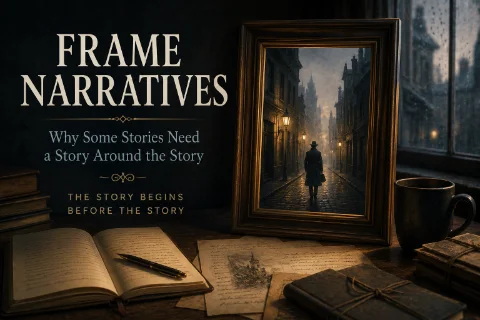
Think of it like a painting inside a frame. The picture may be the center of attention, but the frame changes how we see it.
In fiction, the frame can answer important questions:
Who is telling this story?
Why are they telling it now?
Who is listening?
What has been left out?
Can we trust this version?
What does the act of telling reveal?
A frame narrative gives the story a second pulse. One pulse belongs to the events. The other belongs to the telling of those events.
Why Some Stories Need a Frame
Not every story needs a frame narrative. Some stories are strongest when they begin directly and move forward without extra layers.
But some stories need distance.
Some need mystery.
Some need memory.
Some need the feeling that the truth has been buried and is being recovered piece by piece.
A frame narrative is useful when the story is not only about what happened, but about how what happened survives.
A war story told by an old soldier is different from a war story happening in the present.
A love story found in a box of letters is different from a love story told as it unfolds.
A ghost story told at midnight by someone who still refuses to enter one room is different from a ghost story told plainly.
The frame creates atmosphere before the inner story even begins.
It tells the reader, “There is a reason this story is being told.”
The Frame as a Promise
A frame narrative makes a promise to the reader.
It suggests that the story has weight beyond its events. Someone carried it. Someone preserved it. Someone could not forget it. Someone needed to confess it. Someone wanted to warn others.
The frame gives the inner story consequence.
For example, a character may begin by saying:
“I did not believe in curses until the winter I spent at Blackthorn House.”
This opening does two things. It introduces the outer narrator and prepares the reader for the inner story. It also creates tension because we know the narrator survived long enough to speak, but we do not know what survival cost them.
A frame can make the reader ask:
Why is this being told now?
What happened to the person telling it?
What has changed since the events ended?
Is the narrator trying to understand the past, or escape it?
That curiosity becomes part of the reading experience.
Memory as a Storytelling Device
Frame narratives are often connected to memory.
Memory is not a clean window. It is a room full of dust, light, locked boxes, and missing furniture. When a character tells a story from memory, the reader must pay attention not only to the events, but also to the shape of the remembering.
What does the narrator remember clearly?
What do they avoid?
What details feel too sharp?
What details are strangely absent?
What do they repeat?
What do they excuse?
A framed story allows memory to become active. The past is not simply shown. It is being rebuilt in the present by someone with emotions, wounds, motives, and blind spots.
That makes the story feel human.
People do not remember life in perfect order. They circle it. They protect themselves from it. They return to certain moments again and again because those moments still hurt.
A frame narrative can capture that beautifully.
The Unreliable Teller
One of the most exciting uses of a frame narrative is unreliability.
When a story is told through a character, diary, confession, interview, or discovered document, the reader must ask whether the teller is honest, mistaken, ashamed, confused, or manipulative.
This does not mean the narrator must be lying.
Unreliability can be subtle.
A narrator may genuinely believe their version.
They may misunderstand another character.
They may hide their own guilt.
They may romanticize the past.
They may turn themselves into the hero of a story where they were not innocent.
A frame narrative lets the writer create tension between the story told and the truth underneath it.
Sometimes the most interesting part of a framed story is not the inner tale itself, but the cracks in the telling.
Stories Within Stories: A Mirror Effect
Frame narratives often create mirrors.
The outer story and inner story can reflect each other. A character listening to a tale may face a similar choice later. A legend told in the beginning may quietly explain the present. A manuscript from the past may reveal the emotional pattern repeating in a family.
This mirror effect gives the story depth.
For example:
A young woman reads her grandmother’s diary and realizes they both loved people they were forbidden to love.
A journalist interviews a prisoner and slowly recognizes their own moral compromise.
A child hears a fairy tale that later becomes a map for surviving real danger.
A scholar translates an ancient myth and discovers that the myth is not dead at all.
The inner story can become a key to the outer one.
When done well, the frame and the inner narrative do not feel separate. They speak to each other.
Creating Distance Without Losing Emotion
Some stories are too painful, strange, or large to tell directly.
A frame narrative can create emotional distance while still preserving intensity.
For grief, trauma, myth, family secrets, historical violence, or supernatural events, the frame allows the writer to approach the subject carefully. The outer story gives the reader a place to stand before entering darker material.
Distance can make emotion stronger.
A direct scene of loss may be powerful, but a character describing that loss years later, still unable to say one name, can be devastating in a different way.
The frame tells us that the event did not end when it ended.
It continued inside the person who survived it.
The Discovered Manuscript
One classic form of frame narrative is the discovered manuscript.
A character finds a journal, old letters, a confession, a recorded message, a translated text, or a hidden book. The discovered object becomes the doorway into the inner story.
This structure works especially well for mystery, gothic fiction, historical fiction, fantasy, horror, and literary fiction.
The discovered manuscript raises instant questions:
Who wrote this?
Why was it hidden?
Who was meant to find it?
Is it complete?
Was it altered?
What danger comes from reading it?
The object itself becomes part of the plot. It is not only a container for information. It carries history, secrecy, and risk.
A diary found in a locked attic feels different from a story told openly at a dinner table. The form changes the mood.
The Listener Matters Too
In a frame narrative, the listener is often as important as the teller.
A story changes depending on who receives it.
A confession told to a priest is different from one told to a daughter.
A battlefield memory told to a stranger is different from one told to a former enemy.
A grandmother’s tale told to a child may hide truths the child will only understand years later.
The listener can create pressure. They can interrupt, doubt, misunderstand, or transform because of what they hear.
Sometimes the outer story is really about the listener changing.
They begin as someone curious.
They end as someone burdened with knowledge.
That is one of the quiet beauties of frame narratives. Stories are not harmless objects. They pass from one person to another and change the person who receives them.
How a Frame Changes the Reader’s Trust
When a story has a frame, the reader becomes more aware of storytelling itself.
We are not only watching events. We are watching the act of narration.
This can create intimacy because it feels like someone is speaking directly to us. It can also create suspicion because the story has passed through someone’s mind before reaching us.
The writer can use this tension carefully.
A clean, honest frame may make the story feel like a private confession.
A strange or broken frame may make the story feel unstable.
A formal frame may make the story feel historical or official.
A casual frame may make the story feel like gossip, rumor, or oral tradition.
Each choice changes the reader’s relationship with the truth.
Common Types of Frame Narratives
The Confession Frame
A character tells the truth after hiding it for years. This works well for guilt, crime, regret, and moral conflict.
The Memory Frame
An older narrator looks back on youth, love, loss, or a turning point. This works well for literary fiction and coming-of-age stories.
The Manuscript Frame
A written record is found, read, translated, or preserved. This works well for mystery, gothic fiction, fantasy, and historical fiction.
The Interview Frame
One character questions another. This works well when truth must be extracted slowly.
The Campfire Frame
A story is told aloud to a group. This works well for horror, folklore, adventure, and mythic storytelling.
The Trial or Testimony Frame
A character gives an account before judgment. This works well for stories about justice, truth, and reputation.
How to Write a Strong Frame Narrative
1. Give the Frame a Purpose
Do not add a frame only because it sounds artistic. The outer story should change how the inner story is understood.
2. Create a Reason for Telling
The narrator should have a reason to speak now. Confession, warning, memory, survival, explanation, inheritance, or fear can all work.
3. Make the Outer Story Matter
The frame should not disappear completely unless that is intentional. It should return with meaning.
4. Let the Frame Add Tension
The reader should wonder about the teller, the listener, the truth, or the consequences of the story being told.
5. Use Voice Carefully
The outer narrator’s voice should feel distinct. Their way of telling should reveal who they are.
6. Connect the Inner and Outer Stories
The two layers should reflect, challenge, or complete each other.
7. Avoid Overcomplication
A frame should deepen the story, not confuse the reader without purpose.
Example: A Simple Story With and Without a Frame
Direct version:
“Clara entered the old lighthouse and found a room full of letters.”
Framed version:
“Forty years later, Clara would tell her granddaughter that the lighthouse had never frightened her. Not at first. Fear came only after she found the letters, tied with blue thread, each one addressed to a woman who had been dead for a hundred years.”
The framed version adds distance, mystery, and consequence. We know Clara survived. We know the event stayed with her. We know she is choosing to tell it after many years. The story now has two timelines, the event itself and the memory of the event.
That second layer creates depth.
When Not to Use a Frame Narrative
A frame narrative is not always the right choice.
Avoid using one if it only delays the real story without adding meaning. A weak frame can feel like a decorative border around a picture that does not need it.
You may not need a frame if:
The main story is already clear and immediate.
The narrator’s act of telling does not matter.
The outer story has no tension.
The frame explains too much too early.
The structure makes the story feel slower rather than richer.
A frame should create resonance. If it only creates distance, consider beginning directly.
The Story That Carries the Story
A frame narrative reminds us that stories do not exist in empty space.
They are told by someone.
They are heard by someone.
They survive for a reason.
Sometimes the story around the story is where the real meaning waits. The frame can reveal guilt, memory, inheritance, doubt, fear, and longing. It can make a simple event feel like a legend. It can make an old wound feel newly opened. It can make the reader question not only what happened, but why this version of what happened has reached them.
Some stories need a frame because they are not only about events.
They are about the burden of telling.
They are about the person who carries the tale.
They are about the silence before the first sentence and the change that comes after the last one.
A frame narrative is more than a border.
It is the hand holding the story up to the light.