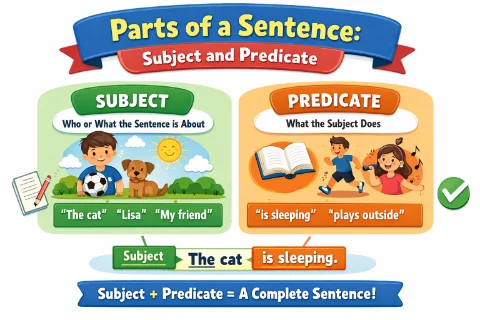
Every complete sentence has a structure. No matter how short or long a sentence is, it usually contains two main parts:
- Subject
- Predicate
Understanding these two parts is one of the most important steps in learning English grammar. Once you can identify the subject and predicate, it becomes much easier to understand sentence structure and write clear sentences.
In this lesson, you will learn what subjects and predicates are, how they work together, and how to identify them in any sentence.
What Are the Parts of a Sentence?
Most sentences are made up of two main parts:
- Subject
- Predicate
Together, these parts create a complete thought.
Example:
"The dog barked loudly."
Subject:
- The dog
Predicate:
- barked loudly
The subject tells us who or what the sentence is about.
The predicate tells us what the subject does or what happens to the subject.

What Is a Subject?
The subject is the person, place, thing, or idea that the sentence is about.
The subject usually answers the question:
"Who?" or "What?"
Examples
- Sarah reads books.
- The bird sings.
- My brother plays football.
Subjects:
- Sarah
- The bird
- My brother
Each subject tells us who is performing the action.
What Is a Predicate?
The predicate is the part of the sentence that tells us something about the subject.
The predicate always contains a verb.
Examples
- Sarah reads books.
- The bird sings.
- My brother plays football.
Predicates:
- reads books
- sings
- plays football
The predicate explains what the subject does or what happens.
Subject and Predicate Working Together
Think of a sentence as a team.
The subject introduces the person or thing.
The predicate tells us something about that person or thing.
Example:
"The teacher explained the lesson."
Subject:
- The teacher
Predicate:
- explained the lesson
Together, they form a complete sentence.
Simple Examples
Example 1
Sentence:
"The cat sleeps."
Subject:
- The cat
Predicate:
- sleeps
Example 2
Sentence:
"John runs quickly."
Subject:
- John
Predicate:
- runs quickly
Example 3
Sentence:
"The flowers bloom every spring."
Subject:
- The flowers
Predicate:
- bloom every spring
Complete Subject and Simple Subject
Subjects can be simple or complete.
Simple Subject
The main noun or pronoun.
Example:
"The little puppy barked."
Simple subject:
- puppy
Complete Subject
The subject and all its describing words.
Example:
"The little puppy barked."
Complete subject:
- The little puppy
Complete Predicate and Simple Predicate
Predicates can also be simple or complete.
Simple Predicate
The main verb.
Example:
"The little puppy barked loudly."
Simple predicate:
- barked
Complete Predicate
The verb and all related words.
Example:
"The little puppy barked loudly."
Complete predicate:
- barked loudly
More Examples
Sentence
"The red car stopped suddenly."
Subject:
- The red car
Predicate:
- stopped suddenly
Sentence
"My friends are visiting tomorrow."
Subject:
- My friends
Predicate:
- are visiting tomorrow
Sentence
"The students completed their homework."
Subject:
- The students
Predicate:
- completed their homework
Questions and Commands
Sometimes the subject is not obvious.
Commands
Example:
"Close the door."
The subject is understood as:
- You
Subject:
- (You)
Predicate:
- close the door
Questions
Example:
"Are the children ready?"
Subject:
- the children
Predicate:
- are ready
Even in questions, every complete sentence has a subject and predicate.
How to Identify the Subject
Ask:
"Who or what is this sentence about?"
Example:
"The airplane landed safely."
Who or what is the sentence about?
The airplane.
Subject:
- The airplane
How to Identify the Predicate
After finding the subject, everything else that tells us something about it is the predicate.
Example:
"The airplane landed safely."
Predicate:
- landed safely
Common Mistakes
Mistake 1
Confusing the subject with the first word.
Sentence:
"On the table sat a vase."
Subject:
- a vase
Not:
- On
The subject is who or what the sentence is about.
Mistake 2
Missing the complete predicate.
Sentence:
"The dog barked loudly at the stranger."
Complete predicate:
- barked loudly at the stranger
Not just:
- barked
Mistake 3
Ignoring descriptive words in the subject.
Sentence:
"The tall building overlooks the city."
Complete subject:
- The tall building
Not just:
- building
Practice Exercise
Identify the subject and predicate.
1
Sentence:
"The baby laughed happily."
Subject:
- The baby
Predicate:
- laughed happily
2
Sentence:
"My sister loves music."
Subject:
- My sister
Predicate:
- loves music
3
Sentence:
"The train arrived on time."
Subject:
- The train
Predicate:
- arrived on time
4
Sentence:
"The children played in the park."
Subject:
- The children
Predicate:
- played in the park
5
Sentence:
"The sun shines brightly."
Subject:
- The sun
Predicate:
- shines brightly
Quick Quiz
Identify the subject.
- The dog chased the ball.
- Sarah enjoys painting.
- The old tree fell during the storm.
Answers:
- The dog
- Sarah
- The old tree
Identify the predicate.
- chased the ball
- enjoys painting
- fell during the storm
Summary
Every complete sentence has two main parts:
Subject
The person, place, thing, or idea the sentence is about.
Examples:
- John
- The dog
- My teacher
Predicate
The part that tells us something about the subject.
Examples:
- runs quickly
- barked loudly
- explained the lesson
Key points to remember:
- The subject tells who or what the sentence is about.
- The predicate tells what the subject does or is.
- Every complete sentence contains a subject and a predicate.
- Subjects and predicates can be simple or complete.
- Learning to identify them makes reading and writing much easier.
Understanding subjects and predicates gives you a strong foundation for learning more advanced grammar topics and building clear, effective sentences.