Imagine you accidentally drop your phone.
You might immediately say:
"Ouch!"
Or perhaps you receive exciting news and shout:
"Wow!"
These words express sudden feelings or emotions. They are called interjections.
Interjections are among the most expressive parts of speech because they help us communicate emotions quickly and naturally.
What Is an Interjection?
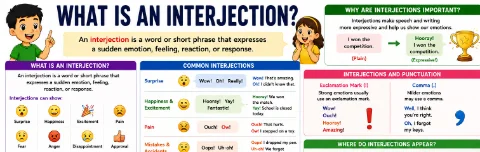
An interjection is a word or short phrase that expresses a sudden emotion, feeling, reaction, or response.
Interjections can show:
- Surprise
- Happiness
- Excitement
- Pain
- Fear
- Anger
- Disappointment
- Approval
Examples:
- Wow!
- Ouch!
- Hooray!
- Oh!
- Alas!
- Oops!

Why Are Interjections Important?
Interjections make speech and writing more expressive.
Compare:
- I won the competition.
- Hooray! I won the competition.
The second sentence communicates excitement much more clearly.
Interjections help readers and listeners understand emotions instantly.
Common Interjections
Here are some common interjections used in everyday English:
Surprise
- Wow!
- Oh!
- Really!
Examples:
- Wow! That's amazing.
- Oh! I didn't know that.
Happiness and Excitement
- Hooray!
- Yay!
- Fantastic!
Examples:
- Hooray! We won the match.
- Yay! School is closed today.
Pain
- Ouch!
- Ow!
Examples:
- Ouch! That hurts.
- Ow! I stepped on a toy.
Mistakes and Accidents
- Oops!
- Uh-oh!
Examples:
- Oops! I dropped my pen.
- Uh-oh! We forgot the tickets.
Sadness
- Alas!
Example:
- Alas! The hero could not save the kingdom.
Relief
- Phew!
Example:
- Phew! I finished the project on time.
Interjections and Punctuation
Interjections are often followed by punctuation marks.
Exclamation Mark (!)
Strong emotions usually use an exclamation mark.
Examples:
- Wow!
- Ouch!
- Hooray!
- Amazing!
Comma (,)
Milder emotions may use a comma.
Examples:
- Well, I think you're right.
- Oh, I forgot my keys.
The punctuation depends on the strength of the feeling.
Interjections in Sentences
Interjections can appear at the beginning of a sentence.
Examples:
- Wow! That building is huge.
- Oops! I made a mistake.
- Hooray! Our team won.
They can also appear in the middle of a sentence.
Examples:
- This cake is, wow, incredibly delicious.
- That was, oh, quite unexpected.
They may even appear alone.
Examples:
- Ouch!
- Yay!
- Alas!
Types of Interjections
Interjections of Joy
Express happiness or excitement.
Examples:
- Hooray!
- Yay!
- Wonderful!
Sentence:
- Hooray! Summer vacation has started.
Interjections of Surprise
Express shock or amazement.
Examples:
- Wow!
- Oh!
- Ah!
Sentence:
- Wow! That waterfall is beautiful.
Interjections of Pain
Express physical discomfort.
Examples:
- Ouch!
- Ow!
Sentence:
- Ouch! I burned my finger.
Interjections of Approval
Express agreement or praise.
Examples:
- Bravo!
- Excellent!
Sentence:
- Bravo! You performed wonderfully.
Interjections of Disappointment
Express sadness or regret.
Examples:
- Alas!
- Oh no!
Sentence:
- Alas! The opportunity was lost.
How to Identify an Interjection
Ask yourself:
"Does this word express a sudden feeling or emotion?"
Example:
- Wow! That's a beautiful painting.
What feeling is being expressed?
Surprise and admiration.
The word wow is an interjection.
Another example:
- Oops! I sent the wrong email.
What feeling is being expressed?
Recognition of a mistake.
The word oops is an interjection.
Interjections in Everyday Conversation
Interjections are very common in spoken English.
Examples:
- Wow! That's incredible.
- Oh, I understand now.
- Oops! Sorry about that.
- Phew! That was close.
- Yay! We did it.
Using interjections naturally can make conversations sound more friendly and expressive.
Common Mistakes
Mistake 1
Using too many interjections.
Incorrect:
- Wow! Yay! Amazing! Fantastic! Great!
Correct:
- Wow! That's amazing.
Too many interjections can make writing feel unnatural.
Mistake 2
Using an interjection without proper punctuation.
Incorrect:
- Wow that is beautiful.
Correct:
- Wow! That is beautiful.
Strong emotions usually require an exclamation mark.
Mistake 3
Confusing interjections with regular sentence words.
Example:
- Well, let's begin.
In this sentence, well functions as an interjection introducing the statement.
Context determines its role.
Practice Exercise
Identify the interjection in each sentence.
- Wow! That sunset is beautiful.
- Oops! I forgot my homework.
- Hooray! We won the championship.
- Phew! That exam was difficult.
- Oh! I recognize that song.
Answers:
- Wow
- Oops
- Hooray
- Phew
- Oh
Quick Quiz
Are these words interjections?
- Wow ✔
- Ouch ✔
- Table ✘
- Hooray ✔
- Run ✘
- Oops ✔
Remember, interjections express emotions, reactions, or sudden feelings.
Summary
An interjection is a word or short phrase that expresses emotion, reaction, or feeling.
Examples:
- Wow!
- Ouch!
- Hooray!
- Oops!
- Alas!
- Phew!
Key points to remember:
- Interjections express sudden emotions.
- They are often followed by an exclamation mark.
- They can stand alone or appear within sentences.
- They make speech and writing more expressive.
- Common interjections include wow, ouch, hooray, and oops.
Although interjections are usually short, they play a powerful role in communication by helping us express emotions quickly and naturally.