Imagine reading this sentence:
"The boy runs."
You know what the boy is doing, but you do not know how he runs.
Now read:
"The boy runs quickly."
The word quickly gives us more information about the action. It tells us how the boy runs.
Words like quickly are called adverbs.
Adverbs help make sentences more detailed and interesting by adding information about actions, descriptions, and other qualities.
What Is an Adverb?
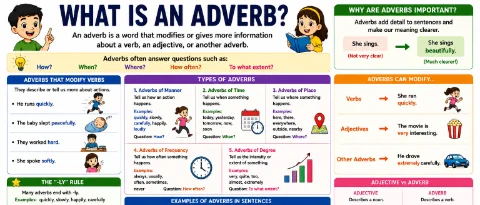
An adverb is a word that modifies or gives more information about a verb, an adjective, or another adverb.
Adverbs often answer questions such as:
- How?
- When?
- Where?
- How often?
- To what extent?
Examples:
- quickly
- slowly
- yesterday
- here
- always
- very
Why Are Adverbs Important?
Without adverbs, many sentences would feel incomplete.
Compare these sentences:
- She sings.
- She sings beautifully.
The second sentence gives us a clearer picture of how she sings.
Adverbs make communication more precise and expressive.

Adverbs That Modify Verbs
Most adverbs describe actions.
Examples:
- He runs quickly.
- The baby slept peacefully.
- They worked hard.
- She spoke softly.
In each sentence, the adverb tells us more about the verb.
Adverbs That Modify Adjectives
Adverbs can also describe adjectives.
Examples:
- very tall
- extremely cold
- quite easy
- incredibly strong
Sentences:
- The building is very tall.
- The water is extremely cold.
The adverbs very and extremely strengthen the adjectives.
Adverbs That Modify Other Adverbs
Sometimes adverbs describe other adverbs.
Examples:
- very quickly
- extremely slowly
- quite carefully
Sentences:
- She ran very quickly.
- He drove extremely carefully.
The adverbs very and extremely modify other adverbs.
Types of Adverbs
Adverbs of Manner
These tell us how an action happens.
Examples:
- quickly
- slowly
- carefully
- happily
- loudly
Sentences:
- She danced gracefully.
- The teacher explained clearly.
Question answered:
How?
Adverbs of Time
These tell us when something happens.
Examples:
- today
- yesterday
- tomorrow
- now
- soon
Sentences:
- We arrived yesterday.
- The meeting starts soon.
Question answered:
When?
Adverbs of Place
These tell us where something happens.
Examples:
- here
- there
- everywhere
- outside
- nearby
Sentences:
- Please sit here.
- The children are playing outside.
Question answered:
Where?
Adverbs of Frequency
These tell us how often something happens.
Examples:
- always
- usually
- often
- sometimes
- never
Sentences:
- I always brush my teeth.
- She rarely watches television.
Question answered:
How often?
Adverbs of Degree
These tell us the intensity or extent of something.
Examples:
- very
- quite
- too
- almost
- extremely
Sentences:
- The movie was very interesting.
- The soup is too hot.
Question answered:
To what extent?
How to Identify an Adverb
A simple trick is to ask questions about the action or description.
Example:
"The athlete runs quickly."
How does the athlete run?
Quickly.
The word quickly is the adverb.
Another example:
"The exam was extremely difficult."
How difficult?
Extremely difficult.
The word extremely is the adverb.
The "-ly" Rule
Many adverbs end with -ly.
Examples:
- quickly
- slowly
- happily
- carefully
- quietly
However, not all adverbs end with -ly.
Examples:
- often
- always
- never
- here
- there
- soon
And not every word ending in -ly is an adverb.
Examples:
- friendly
- lovely
- lonely
These are usually adjectives.
Examples of Adverbs in Sentences
- The dog barked loudly.
- She answered politely.
- We arrived early.
- They often visit their grandparents.
- The train moved slowly.
Adverbs:
- loudly
- politely
- early
- often
- slowly
Adjective vs Adverb
Many learners confuse adjectives and adverbs.
Adjective
Describes a noun.
Example:
- She is a quick runner.
Quick describes the noun runner.
Adverb
Describes a verb.
Example:
- She runs quickly.
Quickly describes the verb runs.
Common Adverbs
Here are some frequently used adverbs:
- quickly
- slowly
- quietly
- loudly
- happily
- sadly
- always
- often
- never
- sometimes
- very
- almost
- too
- here
- there
- now
- soon
- yesterday
- today
- carefully
Common Mistakes
Mistake 1
Incorrect:
"He speaks quick."
Correct:
"He speaks quickly."
An adverb should modify the verb.
Mistake 2
Incorrect:
"She is a beautifully singer."
Correct:
"She is a beautiful singer."
Adjectives describe nouns, not adverbs.
Mistake 3
Incorrect:
"The baby cried loud."
Correct:
"The baby cried loudly."
Use the correct adverb form when describing an action.
Practice Exercise
Identify the adverb in each sentence.
- The cat slept peacefully.
- She always arrives early.
- We will meet tomorrow.
- The students worked carefully.
- He spoke very softly.
Answers:
- peacefully
- always
- tomorrow
- carefully
- very, softly
Quick Quiz
Are these words adverbs?
- quickly ✔
- chair ✘
- always ✔
- beautiful ✘
- slowly ✔
- teacher ✘
Remember, adverbs usually tell us how, when, where, how often, or to what extent.
Summary
An adverb is a word that modifies a verb, adjective, or another adverb.
Examples:
- quickly
- slowly
- always
- here
- very
- carefully
Key points to remember:
- Adverbs add extra detail to sentences.
- They can describe actions, qualities, or other adverbs.
- Many adverbs end in -ly.
- They often answer how, when, where, how often, or to what extent.
- Adverbs help make writing clearer and more precise.
Once you understand adverbs, you can create more detailed and expressive sentences that communicate exactly what you mean.