Introduction: The Moment the Story Cannot Undo
Some moments in fiction do not explode.
They do not always arrive with violence, death, betrayal, or a dramatic confession. Sometimes they are quiet. A hand pulls away. A door stays closed. A name is not spoken. A character reads one sentence and understands their life has split into before and after.
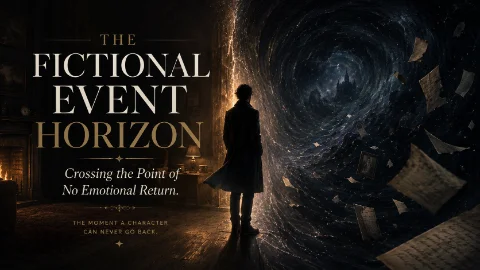
This is the fictional event horizon.
It is the point of no emotional return.
In physics, an event horizon is the boundary around a black hole beyond which nothing can escape. In storytelling, the fictional event horizon is the emotional boundary a character crosses when they can no longer return to their old self, old belief, old relationship, or old innocence.
After this point, the plot may continue.
But something inside the character has already passed beyond rescue.
The story has entered gravity.
What Is a Fictional Event Horizon?
A fictional event horizon is the moment in a story when a character crosses an emotional threshold that cannot be uncrossed.
It does not always mean the final climax. It may happen much earlier. It may be the secret discovery, the first betrayal, the irreversible choice, the truth overheard, the act of violence, the moment of surrender, or the instant a character realizes they are capable of something they once feared.
Before the event horizon, the character still has a version of escape.
They can apologize.
They can turn back.
They can pretend.
They can return home.
They can stay innocent.
After the event horizon, even if they survive, even if they win, even if they are forgiven, they are changed.
The emotional universe has altered.
Why This Moment Matters in Creative Writing
Readers remember stories that change people.
A plot can be clever. A twist can be surprising. A setting can be beautiful. But a story becomes unforgettable when the reader feels the exact moment a character becomes unable to go back.
The fictional event horizon gives a narrative emotional force.
It tells the reader:
This matters.
This cannot be erased.
This choice has gravity.
This wound will shape everything after it.
Without such a threshold, a story may feel like events are simply happening one after another. With it, the story gains direction. The character is no longer only moving through scenes. They are being pulled toward consequence.
The Difference Between Plot Change and Emotional Change
Not every major plot event is an event horizon.
A house can burn down, but if the character remains emotionally unchanged, the event may only be external.
A character can receive money, lose a job, move to another country, or survive danger without crossing a true internal boundary.
The fictional event horizon is not about scale.
It is about transformation.
A small moment can carry more emotional weight than a large catastrophe.
A child realizing their parent lied may be more powerful than a battlefield.
A woman deleting one message may matter more than a storm.
A man choosing not to defend someone may become the hidden center of his entire life.
The question is not, “How big is the event?”
The question is, “What can the character never believe again?”
The Invisible Before and After
A strong event horizon divides the story into before and after.
Before, the character may believe love is safe.
After, they know it can be used as a weapon.
Before, they may believe they are innocent.
After, they know what they are capable of.
Before, they may believe their family is whole.
After, every family dinner becomes a performance.
Before, they may believe the world has rules.
After, the world feels lawless.
The reader should feel this split. Scenes after the event horizon should carry different emotional weather. The same room should feel altered. The same dialogue should have sharper edges. The same objects should carry new meaning.
The world does not need to physically change.
The character’s relationship to the world has changed.
Examples of Fictional Event Horizons
A loyal friend tells one lie and realizes how easy betrayal can be.
A daughter finds an old photograph that proves her childhood was built on a false story.
A soldier kills for the first time and cannot return to the person who feared violence.
A husband hears his wife laugh with someone else and understands the marriage has already ended.
A queen signs a death order and discovers power does not feel like triumph, but hunger.
A child watches adults choose silence and learns that truth does not always win.
In each case, the event matters because it alters emotional reality.
The story continues, but innocence has left the room.
The Quiet Event Horizon
Many writers assume the point of no return must be loud.
But quiet event horizons can be even more devastating.
A loud event announces itself. A quiet one creeps under the skin.
A character may cross the boundary by doing nothing.
Not opening the door.
Not answering the call.
Not telling the truth.
Not stopping someone from leaving.
Not saying, “Stay.”
In fiction, omission can be irreversible. The character may spend the rest of the story trying to repair what was broken by a single moment of stillness.
A quiet event horizon is powerful because readers understand how life often changes. Not always through explosions. Sometimes through hesitation.
The Moral Event Horizon
Some fictional event horizons are moral.
A character crosses a line they once believed they would never cross. This may involve betrayal, cruelty, cowardice, revenge, corruption, silence, or complicity.
The moral event horizon does not always turn a character into a villain. It may make them more complex.
They may still love.
They may still suffer.
They may still do good.
But they now carry knowledge of their own capacity for harm.
This is powerful because readers recognize the terror of self-discovery. Sometimes the most frightening revelation is not what another person has done.
It is what the character discovers they are willing to do.
The Emotional Event Horizon in Relationships
Relationships often contain invisible event horizons.
There is a moment when trust breaks beyond repair, even if the people stay together.
There is a moment when love becomes memory.
There is a moment when one character sees another clearly for the first time and can never return to the illusion.
This kind of threshold is especially useful in romance, family drama, literary fiction, psychological fiction, and tragedy.
A relationship may continue for chapters after the event horizon, but the reader knows something has already died.
That creates tension.
The characters may still speak kindly.
They may still share a house.
They may still act as if nothing has changed.
But the emotional truth has crossed the boundary.
The Event Horizon as Narrative Gravity
After a character crosses the fictional event horizon, the story gains gravitational pull.
Everything begins to bend toward consequence.
Choices become harder.
Secrets become heavier.
Old beliefs collapse.
Relationships strain.
The past becomes impossible to ignore.
The event does not need to be mentioned constantly. Its force should be felt. Like gravity, it works even when invisible.
A good writer lets the event horizon affect the texture of later scenes.
The character may speak less.
They may become reckless.
They may avoid a place.
They may become obsessed with one object.
They may treat kindness as suspicion.
They may laugh at the wrong time.
The event has changed their internal physics.
How to Build Toward the Point of No Emotional Return
A fictional event horizon works best when the story prepares for it.
The reader should sense pressure gathering before the threshold is crossed.
Small warnings help:
A repeated hesitation.
A secret almost revealed.
A relationship growing brittle.
A character rehearsing a choice before making it.
A line they keep saying they would never cross.
A room they avoid.
A truth everyone talks around.
The event horizon should feel both surprising and inevitable. The reader should think, “I did not know it would happen like this, but I understand why it happened.”
That balance creates power.
How to Write the Moment Itself
When writing the event horizon, avoid explaining too much.
The moment should have space to breathe.
Focus on concrete details. A sound. A gesture. A sentence. A physical sensation. The ordinary world continuing around the extraordinary internal shift.
For example:
“After she read the letter, the kettle began to whistle. She stood beside the stove and let it scream until the water burned away.”
The emotional change is not explained directly. It is shown through stillness, neglect, and sound.
The reader feels the crossing.
After the Crossing: Showing Consequence
The event horizon only matters if the story changes afterward.
If the character behaves exactly the same, the threshold loses force.
Consequence does not need to be immediate. It can unfold slowly.
A character may deny the change at first.
They may try to return to normal.
They may pretend the old world still exists.
But the reader should see cracks.
A familiar song now hurts.
A familiar face now seems dangerous.
A promise now sounds impossible.
A home now feels staged.
The event horizon should haunt the remaining narrative.
The False Event Horizon
Sometimes writers can use a false event horizon.
This is a moment that seems irreversible, but later the story reveals that a deeper threshold is still ahead.
A character may think they crossed the line when they lied.
Later, they discover the true crossing happens when they defend the lie.
A character may think the relationship ended with the argument.
Later, they realize it ended when they stopped wanting to be understood.
A false event horizon can create layered emotional structure. It shows that people often misunderstand the exact moment their lives changed.
The real wound may be quieter than the obvious disaster.
How to Know If Your Story Has an Event Horizon
Ask these questions:
What moment changes what the character can believe?
What choice cannot be emotionally undone?
What truth divides the story into before and after?
What action, silence, or discovery alters the character’s inner world?
What scene makes return impossible?
If you cannot identify such a moment, your story may still work, but it may lack emotional gravity.
A strong event horizon gives the reader something to feel beneath every later scene.
Common Mistakes Writers Make
Making the Event Too Loud
Drama does not always equal emotional depth. A quieter moment may be more powerful.
Skipping the Aftermath
The crossing must change the story afterward. Otherwise it is only a dramatic scene.
Confusing Shock With Consequence
A shocking event may surprise readers, but consequence is what gives it meaning.
Explaining the Change Too Directly
Trust the reader. Let behavior, silence, and altered perception reveal transformation.
Placing It Too Late Without Purpose
If the event horizon appears only at the very end, readers may not experience its gravitational effect unless the ending is designed around that impact.
Example: Ordinary Scene vs Event Horizon Scene
Ordinary version:
“David found out his brother had lied to him. He was angry.”
Event horizon version:
“David found the receipt in his brother’s coat pocket. He folded it once, then again, making the paper smaller each time. By the time his brother came home, David had already stopped believing in the word family.”
The second version crosses a threshold. The receipt is small, but the belief that breaks is enormous.
That is the fictional event horizon.
Final Thoughts: The Moment That Changes the Gravity
Every powerful story has a place where the old world ends.
Sometimes the character notices it.
Sometimes only the reader does.
The fictional event horizon is the moment when return becomes impossible, not because the road disappears, but because the person walking it has changed.
They may go home, but home will not mean the same thing.
They may forgive, but innocence will not return.
They may survive, but survival will carry a new shape.
This is where fiction becomes more than a sequence of events. It becomes transformation.
The point of no emotional return is the invisible border every unforgettable character must cross.
And after they cross it, the whole story begins to pull differently.