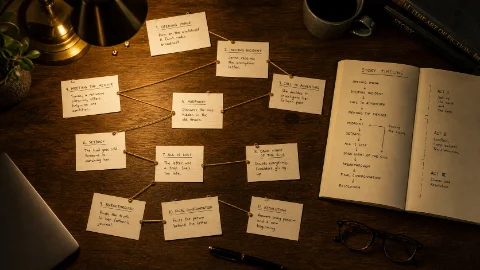
A non-linear timeline is one of the riskiest structural choices a writer can make. Done well, it can transform an ordinary story into something that feels inevitable in its arrangement, where the order of events is as meaningful as the events themselves. Done poorly, it produces confusion, frustrates readers, and drains momentum from a story that might have worked perfectly well told in a straight line.
The difference between these two outcomes is not talent or instinct, though both help. It is structure. A fragmented timeline needs its own skeleton, a hidden architecture that holds the pieces together even as the surface of the narrative jumps across time. This guide breaks down what that skeleton looks like and how to build one that keeps readers moving forward even while the story itself moves backward, sideways, and out of order.
Why Writers Fragment Time
Before getting into the mechanics, it is worth being clear about why a writer would choose to break chronology in the first place. A fragmented timeline is not a default setting. It is a deliberate choice that needs to earn its place, and understanding what it earns helps clarify how to build it.
Meaning that only emerges out of order. Some events do not mean what they mean until later events have provided context. Presenting them in the order they occurred would deliver their significance too early or too late. Rearranging the timeline lets the writer control exactly when the reader understands what something means, which is a form of control that strict chronology does not offer.
The texture of memory. Human memory does not work chronologically. It surfaces in response to triggers, returns to certain moments obsessively, and skips over long stretches of time that did not register as significant. A fragmented timeline that mirrors this quality creates a psychological truth that a linear timeline cannot replicate.
Suspense through structural withholding. When a story moves between a present timeline and a past one, the reader often knows that something happened in the past that explains the present, and the fragmented structure becomes the mechanism for delivering that explanation on the writer's schedule rather than the chronological one. This creates a sustained question that pulls the reader through the entire book.
Thematic resonance across time. Placing two moments from different points in a character's life next to each other, regardless of when they happened, can create a meaning through juxtaposition that neither moment contains on its own. The fragmented structure becomes an argument, made through arrangement rather than statement.
If your story does not need one of these effects, a fragmented timeline is probably not the right choice. The technique should solve a problem the story actually has, not be applied because it seems more sophisticated than straightforward chronology.
What "Losing Momentum" Actually Means
Writers who attempt fragmented timelines often sense when something is going wrong but struggle to name it. The complaint usually surfaces as "this feels confusing" or "I lost interest in the middle," but the underlying problem is more specific than either of those descriptions suggests.
Momentum in a non-linear story comes from two sources working together: forward motion within each timeline, and forward motion in the reader's accumulating understanding of how the timelines relate. A fragmented narrative loses momentum when either of these stalls.
The first kind of stall happens when a timeline itself stops developing. If the past sections of a dual or multi-timeline story are static, simply providing information without their own internal tension and progression, those sections will feel like homework the reader has to get through before returning to the timeline that actually matters.
The second kind of stall happens when the relationship between timelines stops deepening. Early in a fragmented narrative, the reader is forming theories: how does this connect to that? What does this scene explain? If the middle of the book confirms what the reader already suspected without adding anything new to the picture, the engine that pulls them through a fragmented structure runs out of fuel.
Both kinds of stall are structural problems, not stylistic ones. They are fixed by building a skeleton that accounts for them from the start, not by polishing prose at the sentence level.
Building the Skeleton: Step One, Find the Chronological Spine
Even though the reader will never experience your story in pure chronological order, you need to know that order yourself, completely and in detail, before you can fragment it intelligently.
Write out, in a private document the reader will never see, every event of your story in the order it actually happened. Include dates or relative time markers. Include events that may never appear directly on the page but that inform the emotional and causal logic of what does appear.
This chronological spine is your reference point for every later decision. It tells you what causes what, what each character knows at any given moment, and what the actual shape of cause and effect looks like underneath the fragmented surface you are about to build. Writers who skip this step often produce fragmented narratives with hidden logical holes, because they never established a coherent underlying chronology to fragment in the first place.
Building the Skeleton: Step Two, Identify the Presentation Order
Once you have the chronological spine, you can begin deciding the order in which the reader will actually encounter events. This is a separate document, and the differences between it and the chronological spine are where your structural skeleton starts to take shape.
For each scene, note its place in the chronological spine and its place in the presentation order. This double-indexing is the single most useful tool for managing a fragmented timeline. It lets you see, at a glance, how far you are jumping at each transition, whether you are moving consistently in one direction or oscillating, and whether any stretch of chronological time is being neglected by the presentation order.
A useful check at this stage is to look for gaps. Is there a period in the chronological spine that the presentation order never visits, even though it is causally important? Is there a period that gets visited five times while another critical period is skipped entirely? These imbalances are easier to catch in a structural document than in a manuscript.
Building the Skeleton: Step Three, Anchor Each Fragment
Every fragment in a non-linear narrative needs an anchor: a piece of information, delivered early and clearly, that tells the reader where and when they are. Without this anchor, the reader spends the first several sentences of each section disoriented, working out the temporal location before they can engage with what is actually happening.
The anchor can be explicit, a date or location heading, or it can be embedded in the prose through specific, immediate detail: a character's age, a historical reference, a technology, a relationship status that the reader already knows belongs to a particular period. Both approaches work. What matters is that the anchor arrives early in the fragment and is unambiguous.
Anchoring is not just about avoiding confusion. It is about giving the reader's developing mental map of the story something to attach the new fragment to. Every time a reader enters a fragment, they are placing it within the structure they have already built in their mind from everything that came before. Strong anchoring makes this placement instant. Weak anchoring forces the reader to do detective work before they can resume reading for the story itself.
Building the Skeleton: Step Four, Design the Transitions
The transition between fragments is where momentum is made or lost. A transition is not simply the gap between one section and the next. It is an active structural choice that should be doing work.
The match cut. Borrowed from film editing, this technique ends one fragment on an image, action, or line that the next fragment picks up, echoes, or completes. A character closing a door in one timeline followed by a character opening a door in another creates a felt connection between the two moments even though they are separated by years. This kind of transition makes the jump between timelines feel motivated rather than arbitrary.
The question-and-partial-answer. End a fragment on an open question, then begin the next fragment, set in a different time, with information that partially but not completely answers it. This creates a chain of partial satisfactions that keeps the reader moving forward, because each transition delivers something even as it opens something new.
The thematic echo. Two fragments that do not share plot connections but that explore the same emotional territory from different angles can be placed next to each other to create meaning through resonance rather than information. This works best when the writer trusts the reader to feel the connection without it being explained.
The deliberate jolt. Sometimes the right transition is an abrupt one, a hard cut with no obvious connective thread, used specifically to create disorientation that mirrors what a character is feeling. This is a powerful tool used sparingly. Used as the default transition throughout an entire novel, it becomes exhausting rather than effective.
Whichever transition type you use at a given moment, the test is the same: does this transition pull the reader forward, or does it simply move them sideways without any sense of momentum carrying across the cut?
Maintaining Independent Momentum Within Each Timeline
A fragmented narrative is usually built from more than one timeline or strand, and each of those strands needs its own internal momentum independent of how the fragments are arranged. This is one of the most commonly skipped steps in non-linear structure, and skipping it is the most common cause of a sagging middle.
Each strand should have its own rising tension, its own developing question, and its own sense of approaching a turning point. If you removed every fragment belonging to the other strands and read this strand alone, it should still read as a story with forward motion, not as a series of static scenes waiting for the other strand to catch up and explain them.
This means planning each strand's internal arc separately before deciding how to interleave them. Map the tension curve of the past timeline on its own. Map the tension curve of the present timeline on its own. Only once both have a real shape should you start deciding how to weave them together, because the weaving needs to respect and amplify both curves rather than flattening either of them into a delivery mechanism for the other.
The Reader's Accumulating Map
One of the most useful ways to think about momentum in fragmented narrative is to imagine the reader building a physical map as they read, a structure in their mind that gets more complete with each fragment.
Early fragments establish the basic pieces of this map: who the characters are, what time periods exist, roughly how they might relate. Middle fragments should be doing one of two things at all times: adding new pieces to the map, or revealing that a piece the reader thought they understood actually means something different from what they assumed.
The second of these, revision of understanding, is one of the most powerful tools available in fragmented narrative and one of the reasons readers tolerate and even seek out non-linear structure. A scene from the past that seemed to mean one thing when the reader first encountered it can mean something completely different once a later fragment recontextualizes it. This recontextualization is only possible because the timeline is fragmented. It is one of the central rewards the form offers in exchange for the extra effort it asks of the reader.
If your middle section is not doing one of these two things in every fragment, either adding to the map or revising it, the reader has nothing new to do with their accumulating understanding, and that is when momentum stalls regardless of how cleverly the individual scenes are written.
How Much Fragmentation Is Too Much
There is no fixed limit to how fragmented a timeline can be, but there is a practical relationship between the number of strands or time periods a narrative juggles and the cognitive load placed on the reader.
Two timelines are the most common and the most manageable configuration. The reader needs to track two sets of circumstances, two casts that may overlap, and one central question about how they connect. This is demanding but well within what most readers can hold comfortably.
Three or more timelines multiply the complexity substantially, not in a linear way but closer to exponentially, because the writer now has to manage the relationships between every pair of timelines as well as each timeline individually. This is achievable, and several acclaimed novels manage it, but it requires more rigorous anchoring, more disciplined transitions, and usually a slower release of information than a two-timeline structure.
The practical test for whether your fragmentation has gone too far is whether a reader who set the book down for a few days and picked it back up could reorient themselves within a page or two. If reorientation requires flipping back through earlier chapters to remember who is who and when is when, the fragmentation has outpaced the anchoring needed to support it.
Common Failures in Non-Linear Structure
Fragmenting before the story needs it. Some writers fragment a timeline because it feels more literary or more sophisticated, without a clear answer to what the fragmentation is doing that chronology could not. This produces structure without purpose, and purposeless structure tends to feel exactly like what it is.
Treating one timeline as filler. When one strand of a fragmented narrative exists only to deliver backstory for the other, that strand will read as less urgent, and readers will start skimming or skipping it. Every strand needs its own genuine stakes.
Withholding information for its own sake. Fragmented structure creates natural opportunities to delay information, but delay only works when it is in service of a satisfying eventual reveal. Information withheld simply to create artificial mystery, without a payoff proportional to the withholding, frustrates readers rather than intriguing them.
Inconsistent anchoring. Some fragments are clearly dated or located while others are not, forcing readers to do more orientation work in some sections than others. Consistency in how you anchor each fragment, even if the method varies, keeps the reading experience from feeling uneven.
Resolving every strand simultaneously at the end. Trying to land the climax of every timeline in the same few pages divides the reader's attention at the moment it should be most concentrated. Most successful fragmented narratives resolve their strands sequentially, allowing each resolution to inform the next, building toward a final convergence rather than detonating everything at once.
A Practical Process for Drafting Non-Linear Fiction
For writers attempting a fragmented timeline for the first time, drafting in chronological order first and fragmenting afterward is often more manageable than trying to write fragments directly in their final presentation order.
Write the full chronological version of your story, even in rough form. This gives you a complete and coherent draft that you understand fully, which is the safest foundation from which to begin breaking the order apart. Once you have that draft, build your double-indexed structural document, mapping chronological position against intended presentation order for every scene.
Reassemble the manuscript according to your presentation order, paying close attention to the transitions at each cut point and to whether each scene, once moved, still carries the anchoring information it needs in its new context. Scenes that worked perfectly in chronological sequence sometimes need additional anchoring or contextual detail once they are relocated, because they can no longer rely on what immediately preceded them in the original order.
This two-pass approach, write straight then fragment, tends to produce more coherent non-linear narratives than attempting to draft directly in fragmented order, because it guarantees that the underlying chronological logic is sound before the more complex work of rearrangement begins.
The Payoff of a Well-Built Skeleton
When a fragmented timeline is built on a structure this deliberate, readers experience something that linear narrative cannot offer: the sense of a story whose meaning is produced not only by what happens but by the specific order in which they are allowed to learn it. That order becomes part of the story's argument, as significant as plot or character.
This is the reward worth working toward, and it is available only through the kind of structural rigor described here. A fragmented timeline that lacks this rigor does not achieve a more sophisticated version of straightforward narrative. It achieves a less coherent one. The skeleton is what makes the difference, and building it before you write, or at least before you finalize your structure, is what allows a fractured surface to hold together as a single, forward-moving story.
The reader should never feel the architecture directly. They should simply feel pulled forward, fragment after fragment, trusting that the next piece will deepen rather than merely repeat what they already understand. That trust is earned entirely by the skeleton underneath, built carefully, before the first page was ever written in its final order.