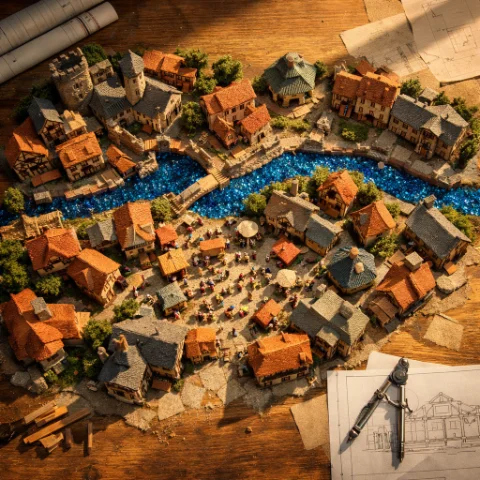
World-building has a branding problem. Mention the term and most people picture maps with invented coastlines, magic systems with carefully balanced rules, and glossaries of made-up words at the back of a fantasy novel. This association is not wrong, but it is incomplete in a way that costs writers working outside fantasy and science fiction a set of skills they actually need just as much.
Every novel, regardless of genre, takes place inside a society. A contemporary literary novel set in a real city still requires the writer to construct a believable social world, one with its own unspoken rules, internal hierarchies, and cultural textures, even when that world is nominally just "the real world." A historical novel needs a society reconstructed with enough precision to feel inhabited rather than researched. Even a story set in a single family kitchen takes place within a constructed social unit that operates according to its own internal logic, one the writer has built whether they thought of it as world-building or not.
This guide treats world-building as a craft skill that belongs to every kind of fiction, not a specialized toolkit reserved for invented worlds. It focuses specifically on the construction of believable societies and cultures, the structures and patterns that make a fictional community feel like it has a real, lived history rather than existing only for the duration of the story being told within it.
Why Societies Need Building Even When They Are Real
It might seem that a contemporary novel set in an actual city does not require world-building in the way a fantasy novel does, since the writer is simply describing a world that already exists. This is only partially true. Even when working with a real setting, the writer is selecting, emphasizing, and constructing a specific version of that world, one shaped by the particular community, profession, family, or subculture the story is actually about.
A novel set among commercial fishermen in a real coastal town still requires the writer to understand and convey the specific social hierarchies of that profession, who has authority and why, what unspoken codes govern behavior on a boat, how outsiders are treated, what economic pressures shape the community's relationship to the industry that sustains it. None of this is invented in the sense that a fantasy kingdom is invented, but all of it requires the same kind of deliberate construction and research that any world-building project demands.
This means the skills of world-building, understanding how social structures cohere, how cultural values get transmitted and enforced, how economic and historical forces shape a community's present reality, are genuinely universal fiction-writing skills. The difference between writing a fantasy world and writing a contemporary social setting is the degree of invention involved, not the underlying craft process.
The Foundation: What Makes a Society Cohere
Before building outward into specific cultural details, it helps to understand the basic structural elements that hold any society together, real or invented. A society that feels believable on the page usually has clear and consistent answers to several foundational questions, even if those answers never appear directly in the text.
How Power Is Distributed
Every society has some system, formal or informal, for determining who has authority over whom and on what basis. This might be hereditary, economic, religious, military, based on age or experience, based on specialized knowledge, or some combination of these and other factors. Understanding clearly how power flows through your invented or recreated society, who can compel whose behavior and through what mechanism, gives you the foundation for understanding nearly every interaction your characters will have with each other and with their social world.
This understanding does not need to be delivered to the reader as exposition. It needs to be consistent enough in the writer's own mind that every scene involving social interaction reflects it accurately. A character who defers to another character should be deferring for a reason the writer understands clearly, even if that reason is never explicitly stated on the page.
How Resources Are Produced and Distributed
What does this society actually do to survive and sustain itself? What is scarce, what is abundant, and how does the distribution of resources, whether that is food, land, currency, or specialized goods, shape relationships between different groups within the society? Economic structure is one of the most under-considered elements of fictional world-building, and it is also one of the most consequential, because economic reality shapes almost everything else about how a society actually functions day to day.
A society's economic structure determines what kinds of work exist, what social status attaches to different kinds of work, how wealth and poverty are distributed and experienced, and what kinds of conflict are likely to arise between people with different economic interests. Understanding this clearly, even in broad strokes, prevents the common world-building failure of societies whose economic logic does not actually hold together under scrutiny.
How Belief and Meaning Are Organized
Every society has some shared framework, whether explicitly religious or more broadly cultural and philosophical, for understanding what matters, what is right and wrong, and what gives life meaning. This framework shapes law, custom, ritual, and the countless small daily behaviors that signal membership in a community and adherence to its values.
This does not require the writer to construct an entire theology or philosophy in exhaustive detail. It requires understanding, at least roughly, what this society collectively believes is good, what it believes is shameful, what it considers sacred or important enough to organize rituals and customs around, and how strictly and through what mechanisms it enforces these beliefs on individuals who deviate from them.
How the Society Relates to Outsiders
A society's identity is partly defined by how it understands itself in relation to people outside it. This includes questions of who is considered a full member of the community and who is not, how outsiders are treated, what happens when someone from outside tries to join, and what historical relationships, whether of alliance, conflict, trade, or domination, exist with neighboring or historically connected groups.
This element is particularly important for any story involving an outsider protagonist or any plot that involves contact between different social groups, since the specific texture of how a society handles difference and contact with the unfamiliar is often where some of fiction's richest dramatic material lives.
Building Culture From the Inside Out
Once the foundational structures of a society are clear, the work of building a believable culture moves into the specific, lived texture that makes a fictional world feel inhabited rather than merely described. This is where the difference between a society that functions logically and a society that feels genuinely real becomes most visible.
Daily Ritual and Routine
The small, repeated actions that make up an ordinary day in a given society carry enormous information about how that society actually works, often more than any direct explanation could convey. What do people eat and when. How is a typical day structured around work, rest, and social obligation. What greetings, gestures, or small courtesies are expected between people of different status or relationship.
These details function the way sensory detail functions in any scene: they create the texture of lived experience rather than abstract description. A society described through its formal institutions and historical events can feel like a textbook entry. The same society shown through what a character eats for breakfast, how they greet a neighbor, what small daily tasks structure their morning, feels inhabited.
Language and the Specific Texture of Speech
How people in your fictional society actually talk, the specific idioms, the formal and informal registers, the things that are considered polite to say directly and the things that must be implied or avoided, reveals more about a culture's values and social structure than almost any other single element.
A culture that values directness will produce dialogue with a different texture than one that values indirection and the careful management of face and reputation. A culture with strict hierarchies will have specific linguistic markers, forms of address, particular vocabulary, that signal relative status between speakers. Even without inventing an entire constructed language, a writer can convey enormous cultural specificity through the patterns and conventions of how characters actually speak to each other.
Material Culture
What objects matter to this society, and why. What is considered valuable, beautiful, shameful to display, or essential to own. How are homes, clothing, and personal possessions organized and decorated, and what do these choices communicate about status, values, and identity within the culture.
Material culture is one of the most efficient world-building tools available because objects can carry enormous implicit information without requiring any direct explanation. A single well-chosen detail about what a character owns, wears, or values materially can communicate social status, cultural background, and personal history more efficiently than several paragraphs of direct description.
Ritual and Ceremony
The formal occasions a society marks, births, comings of age, marriages, deaths, seasonal transitions, achievements, reveal what that society considers significant enough to ritualize, and the specific form those rituals take reveals further information about underlying values and beliefs. A culture that marks death with elaborate, extended public mourning has a different relationship to mortality and community than one that treats death privately and briefly.
Building even a few specific, well-considered rituals for your fictional society, rather than leaving this dimension vague or borrowing generically from real-world traditions without consideration, adds significant depth and specificity to how that society is experienced by the reader.
Conflict, Taboo, and What Cannot Be Said
Every society has things that are forbidden, shameful, or simply not discussed openly, and the specific shape of these taboos reveals as much about a culture as its explicit values do. What would cause genuine scandal in this society. What is quietly tolerated despite official disapproval. What topics make characters visibly uncomfortable, and why.
These taboos and tensions are often where the most interesting dramatic material in a story actually lives, because characters operating within a believable society inevitably encounter moments where personal desire conflicts with social expectation, and the specific shape of that conflict depends entirely on how clearly the writer has understood what this particular society considers acceptable and unacceptable.
Historical Depth and the Illusion of a Living Past
One of the qualities that most reliably distinguishes a believable fictional society from a flat or unconvincing one is the sense that it has a real history, that the present social arrangement is the result of specific past events rather than simply existing because the story requires it to.
This does not require the writer to draft an exhaustive historical timeline before beginning, though some writers find this genuinely useful. It requires understanding, at least in broad strokes, what major events or pressures shaped this society into its current form. What conflicts, migrations, disasters, technological changes, or significant individual actions are part of this society's collective memory, and how does that memory continue to shape present attitudes, even among people who did not personally experience the events being remembered.
A society's relationship to its own history is often visible in small details: what historical figures or events are commemorated and how, what older generations remember differently from younger ones, what grudges or alliances persist from events long past their original context. These details, deployed sparingly but specifically, create the sense of temporal depth that makes a fictional society feel like it existed before the story began and will continue to exist after it ends.
Avoiding the Monolithic Society
One of the most common and most damaging mistakes in constructing fictional societies, in any genre, is treating an entire culture or society as a single, unified entity with one set of beliefs, one perspective, and no meaningful internal variation. Real societies, of any size beyond the smallest isolated group, contain genuine internal diversity: regional differences, class differences, generational differences, dissenting subcultures, and individuals who deviate significantly from whatever the dominant cultural pattern happens to be.
A fictional society that is presented as monolithic, where every member shares identical values and reacts identically to the same situations, feels artificial regardless of how much detail has gone into constructing its surface texture. Building in genuine internal variation, characters who represent different generational attitudes, different class positions, different degrees of conformity or rebellion against dominant social norms, makes a fictional society feel like an actual population of distinct individuals rather than a single collective character wearing many bodies.
This is particularly important when writing about real-world cultures and communities, where presenting any group as monolithic risks flattening genuine human complexity into something closer to stereotype, regardless of how well-researched the surface details might be.
Researching Real-World Societies for Fiction
Writers building a society based closely on a real historical or contemporary culture face a different but related set of challenges from those building something wholly invented. The goal is not invention but accurate, specific, and respectful representation, and this requires its own research discipline.
Primary sources, firsthand accounts, historical documents, oral histories, and works by people from within the culture being represented, provide a level of specific, textured understanding that secondary summaries and general historical overviews cannot replicate. Reading multiple sources that represent different perspectives within the same culture, rather than relying on a single account that might reflect one particular position or experience, helps avoid the monolithic society problem at the research stage itself.
Engaging directly with people from the culture being represented, where this is possible and appropriate, and considering sensitivity readers for cultures the writer does not belong to, are practices that significantly improve the accuracy and respectfulness of how a real or closely modeled society ends up represented on the page, the same practices that apply more broadly to writing characters from backgrounds different from the writer's own.
How Much World-Building Belongs on the Page
A common anxiety among writers doing serious world-building work is how much of that work should actually appear directly in the manuscript. The general principle, which applies across every genre, is that the writer needs to understand far more about their fictional society than the reader ever needs to be told directly.
This extensive background knowledge serves the writing even when it never appears explicitly, because a writer who deeply understands their society's economic structure, power dynamics, and cultural values will write dialogue, behavior, and reaction that consistently reflects that understanding, producing a sense of coherence and depth that readers feel even without ever receiving an explicit explanation of the underlying structure.
Direct exposition about a society's history, structure, or customs should generally be minimized and delivered only when a specific scene genuinely requires it for the reader to understand what is happening, rather than delivered as background information for its own sake. The more reliable method for conveying a society's texture is through specific, concrete detail embedded naturally into scenes: what characters do, say, eat, wear, and react to, rather than through direct authorial explanation of how the society works.
World-Building and Plot
The richest fictional societies are not simply backdrops against which an unrelated plot unfolds. They actively generate the conflicts and stakes the story depends on. A society with clear internal tensions, between classes, generations, competing belief systems, or groups with conflicting interests, provides organic sources of conflict that feel rooted in the world itself rather than imposed on it externally by the demands of plot.
This means that effective world-building for fiction is not simply about creating an interesting or detailed backdrop. It is about constructing a society whose internal structure and tensions can actually generate the specific conflicts your story needs, so that plot and setting feel like a single integrated creation rather than a story that happens to be set inside a separately constructed world.
A Practical Process for Building a Believable Society
For writers approaching this work systematically, a useful sequence is to start with the foundational structural questions, power, resources, belief, and relationship to outsiders, before moving to the more specific textural details of daily ritual, language, material culture, and ceremony. Building the skeleton before the texture tends to produce more coherent results than starting with surface details and trying to retrofit a structural logic underneath them later.
Once the foundational structure and key textural details are established, it helps to stress test the society by asking how specific characters with different positions within it, different class status, different generations, different degrees of conformity, would actually experience and respond to a range of hypothetical situations. If these responses feel predictable and consistent with everything else established about the society, the underlying structure is likely coherent. If they feel arbitrary or contradictory, that is a sign the foundational logic needs further development before the society can support a story built within it.
The Society as a Character
Ultimately, the most useful way to think about world-building a society or culture for fiction is to treat that society the way you would treat any major character: with a clear sense of its history, its values, its internal contradictions, and its capacity to act, react, and exert pressure on the people who live within it. A society, like a character, should feel like it has its own coherent logic, one that exists independently of what any single scene happens to require from it.
This is true whether you are constructing an entirely invented fantasy empire, reconstructing a historical society with documentary care, or simply rendering the specific cultural texture of a real contemporary community your story is set within. The underlying discipline is the same: understand the structure beneath the surface, build outward into specific and consistent detail, and trust that a reader will feel the difference between a world that has been genuinely thought through and one that exists only because the plot needed somewhere to happen.
That difference, more than any single invented detail, is what makes a fictional society feel like a place a reader could actually have visited, rather than a setting they were simply told about.