Introduction: The Story That Refuses to Fight
Many writers are taught the same rule.
A story needs conflict.
A hero wants something.
Something stands in the way.
The struggle creates tension.
The tension creates the story.
This framework has shaped countless novels, films, plays, and television series. It works remarkably well.
But it is not the only way stories can move.
There is another structure, one that has existed for centuries, particularly in East Asian storytelling traditions. A structure that creates curiosity, surprise, emotional resonance, and meaning without requiring characters to oppose each other.
This structure is called Kishōtenketsu.
At first, it can feel strange to writers raised on conflict-driven narratives. Where is the villain? Where is the battle? Where is the obstacle?
The answer is simple.
The story moves through revelation instead of resistance.
The tension comes not from opposition, but from connection.
What Is Kishōtenketsu?
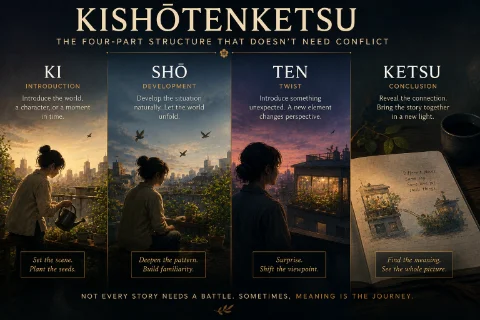
Kishōtenketsu is a four-part narrative structure.
Its name comes from four stages:
Ki (Introduction)
The story introduces its situation, setting, character, or idea.
Shō (Development)
The initial situation develops naturally.
Ten (Twist)
A surprising shift, contrast, or unexpected element appears.
Ketsu (Conclusion)
The story resolves by connecting the earlier elements in a new way.
Unlike many Western story structures, the twist is not necessarily a conflict.
It is often a revelation.
A new perspective.
A hidden relationship.
A surprising contrast.
A piece of information that changes how the reader understands everything that came before.
The power comes from discovery rather than confrontation.
Why Conflict Is Not the Same as Interest
One reason Kishōtenketsu feels refreshing is that it challenges a common assumption.
Conflict creates interest.
But conflict is not the only source of interest.
Human beings are naturally curious.
We enjoy discovering patterns.
We enjoy unexpected connections.
We enjoy seeing how seemingly unrelated things fit together.
We enjoy revelation.
A mystery does not need an argument to be compelling.
A landscape does not need an enemy to be beautiful.
A memory does not need a villain to matter.
Kishōtenketsu relies on this quieter form of engagement.
The reader keeps turning pages not because characters are fighting, but because meaning is unfolding.
The Four Movements of Kishōtenketsu
Ki: Establish the World
The first section introduces the reader to something.
A place.
A person.
A situation.
A daily routine.
A simple observation.
The key is clarity.
The reader should feel grounded.
For example:
A gardener tends a small rooftop garden every morning.
Nothing dramatic happens.
The purpose is orientation.
The story plants seeds.
Shō: Deepen the Pattern
The second section expands what has already been introduced.
The gardener notices the birds.
The weather changes.
The plants grow.
A neighboring rooftop becomes visible.
The narrative deepens without creating conflict.
The story is gathering material.
The reader is learning how this world works.
Ten: Introduce the Unexpected
This is the most important stage.
Something surprising appears.
Not necessarily dangerous.
Not necessarily negative.
Simply unexpected.
Perhaps the gardener discovers an identical garden growing on a rooftop miles away.
Perhaps a bird begins carrying handwritten notes.
Perhaps a photograph reveals the garden existed decades before.
The twist changes perspective.
The story suddenly expands.
Ketsu: Reveal the Connection
The final section creates meaning.
The earlier elements connect.
The reader sees how the introduction and twist belong together.
The surprise gains significance.
The story feels complete.
Not because a conflict was defeated.
Because understanding emerged.
The Twist Is Not a Plot Twist
Many writers misunderstand the Ten section.
It is not necessarily a shocking plot twist.
It does not need betrayal, murder, revelation of secret identities, or sudden danger.
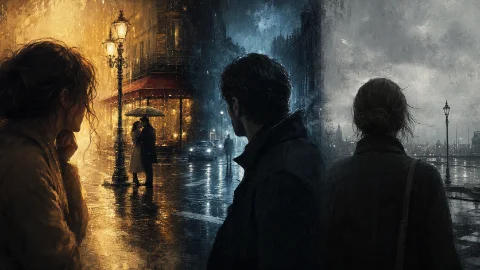
The Ten section often works more like contrast.
Imagine:
Part one shows a lonely lighthouse keeper.
Part two explores his quiet routine.
Part three suddenly shifts to a distant astronaut orbiting Earth.
Part four reveals emotional parallels between their experiences of isolation.
No conflict is required.
The surprise comes from juxtaposition.
Meaning emerges from connection.
That is classic Kishōtenketsu thinking.
Surprise Through Contrast
Kishōtenketsu often generates energy through contrast rather than collision.
Two ideas stand beside each other.
The reader searches for the relationship.
This creates a different emotional experience than conflict.
Conflict asks:
Who will win?
Contrast asks:
How do these things belong together?
The second question often feels more reflective and philosophical.
It invites curiosity rather than competition.
Why This Structure Feels Fresh
Modern storytelling is saturated with escalation.
Higher stakes.
Bigger villains.
More danger.
Louder consequences.
Kishōtenketsu offers another path.
It proves that attention does not always require intensity.
Sometimes readers simply want discovery.
Wonder.
Connection.
Observation.
Meaning.
The structure allows stories to breathe.
It values insight as much as action.
Kishōtenketsu and Creative Writing
Many writers unknowingly use pieces of Kishōtenketsu already.
A symbolic scene.
A surprising image.
A thematic echo.
A revelation that recontextualizes earlier events.
The structure simply makes these techniques central.
Instead of building toward confrontation, it builds toward recognition.
The climax is often understanding itself.
A realization.
A connection.
A shift in perspective.
The story's reward is insight.
The Emotional Power of Revelation
Think about some of the most moving moments in fiction.
Not the fights.
Not the chases.
Not the battles.
The moments of understanding.
When a character finally recognizes a parent.
When two timelines connect.
When a forgotten object gains meaning.
When a mystery suddenly becomes clear.
When a simple gesture reveals years of hidden love.
These moments often feel powerful because they operate on Kishōtenketsu logic.
They are revelations.
The emotional reward comes from seeing differently.
Using Kishōtenketsu in Literary Fiction
Literary fiction often benefits from this structure.
Many literary stories care more about perception than victory.
More about meaning than conquest.
More about transformation than competition.
A story about grief may use Kishōtenketsu beautifully.
The introduction shows ordinary life.
The development explores memory.
The twist introduces an unexpected object or discovery.
The conclusion reveals a new understanding of loss.
No antagonist is necessary.
The emotional journey remains powerful.
Kishōtenketsu in Fantasy and Speculative Fiction
Fantasy writers can use Kishōtenketsu to create wonder.
Instead of focusing only on quests and battles, the structure allows exploration.
Imagine:
A traveler mapping an endless desert.
A strange second location appears.
The two places seem unrelated.
The conclusion reveals they are reflections of each other.
The satisfaction comes from revelation rather than conquest.
This approach often creates stories that feel dreamlike, mythic, or philosophical.
Common Misconceptions
"Nothing Happens"
This is the most common misunderstanding.
Things happen constantly.
The difference is that they are not necessarily conflicts.
Events.
Discoveries.
Connections.
Contrasts.
Insights.
These are all forms of narrative movement.
"There Is No Tension"
Curiosity creates tension.
Questions create tension.
Mystery creates tension.
Wonder creates tension.
Readers do not only crave conflict.
They crave understanding.
"It Is Passive"
A Kishōtenketsu story can contain action.
The difference is that action is not the engine.
Meaning is.
How to Write Using Kishōtenketsu
1. Start With an Observation
Begin with something simple.
A place.
A person.
An image.
A habit.
2. Deepen It
Allow the reader to become familiar with the world.
3. Introduce an Unexpected Contrast
Bring in something that seems unrelated.
Something surprising.
Something that shifts perspective.
4. Find the Hidden Connection
Ask how the original material and the surprise belong together.
5. Trust Curiosity
You do not always need an antagonist.
Sometimes the desire to understand is enough.
6. Think Like a Poet
Kishōtenketsu often works through association.
Images.
Themes.
Patterns.
Echoes.
7. Focus on Revelation
The ending should illuminate rather than defeat.
Example: Conflict Structure vs Kishōtenketsu
Conflict-driven version:
A fisherman struggles against a storm to save his boat.
Kishōtenketsu version:
A fisherman repairs nets each morning.
His routine develops.
The story suddenly shifts to a spider weaving a web inside an abandoned lighthouse.
The conclusion reveals a shared meditation on patience, craftsmanship, and survival.
Both stories work.
They simply create engagement differently.
One through resistance.
The other through connection.
Why Modern Writers Should Study It
Learning Kishōtenketsu does not mean abandoning conflict.
It means expanding your toolbox.
Many stories benefit from conflict.
Others benefit from curiosity.
Some benefit from both.
The more structures a writer understands, the more freedom they have.
Kishōtenketsu teaches a valuable lesson:
Readers do not always need to watch people fight.
Sometimes they want to watch ideas meet.
Sometimes they want to watch patterns emerge.
Sometimes they want to discover a hidden connection that changes everything.
The Beauty of Unexpected Connection
Kishōtenketsu reminds us that storytelling is larger than conflict.
A story can move through wonder.
Through contrast.
Through surprise.
Through recognition.
Through revelation.
The structure asks a different question than traditional narratives.
Not:
"What stands in the way?"
But:
"What hidden connection waits to be discovered?"
That question can create stories that feel reflective, elegant, and quietly unforgettable.
Because sometimes the most powerful moment in a story is not the defeat of an enemy.
It is the instant two seemingly unrelated things suddenly fit together.
And the reader sees the whole world differently.