Introduction: The Character Who Is Both Guilty and Innocent
Some characters explain themselves.
Others refuse.
They act. They wound. They save. They betray. They protect. They disappear. But when the reader reaches the final page, one question still remains alive.
Why did they do it?
Not because the writer forgot to answer. Not because the plot was careless. Not because the character was unfinished.
Because the uncertainty is the point.
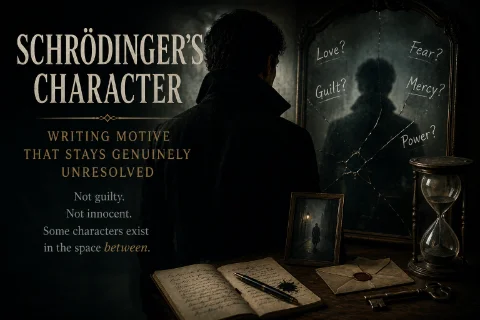
A Schrödinger's character is a character whose motive remains suspended between possible truths. Like a locked box that may contain one answer or another, the character is never fully opened. The reader is left holding more than one version of them at the same time.
They may be selfish or selfless.
Cruel or merciful.
Loving or manipulative.
Broken or calculating.
The power of this kind of character is not confusion. It is controlled ambiguity. The reader does not feel cheated. The reader feels haunted.
What Is a Schrödinger's Character?
A Schrödinger's character is a figure whose true motive cannot be fully confirmed.
The story gives clues, but not a final verdict. Their actions can be interpreted in more than one way. Every explanation seems possible, yet none completely wins.
They may commit an act that looks like betrayal, but it may also be protection.
They may help someone, but perhaps only to control them.
They may confess, but the confession may be incomplete.
They may love another character, but love may not be the only thing driving them.
This kind of character lives in the space between answers.
The reader does not simply ask, “What happened?”
The reader asks, “What kind of person have I been watching?”
Why Unresolved Motive Can Be Powerful
In real life, motives are rarely clean.
People do not always understand themselves. They act from fear, pride, loyalty, desire, shame, memory, survival, hunger, love, and anger all at once. A person can do the right thing for the wrong reason. A person can do harm while believing they are saving someone.
Fiction often tries to simplify motive because clarity feels satisfying. But sometimes a story becomes more truthful when motive remains unstable.
Unresolved motive can make a character feel more human.
It can also make the reader participate. Instead of receiving a final explanation, the reader becomes a judge, witness, detective, and haunted companion.
The unanswered motive keeps echoing after the story ends.
Ambiguity Is Not the Same as Vagueness
There is an important difference between ambiguity and vagueness.
Vagueness happens when the writer has not given enough information.
Ambiguity happens when the writer has given enough information to support more than one meaningful interpretation.
A vague character feels empty.
An ambiguous character feels layered.
If a character burns a letter and the story never gives context, the reader may feel lost. But if the story shows that the letter could expose a crime, protect a child, destroy a marriage, or reveal the character's own shame, the act becomes charged with possibility.
The reader may never know the exact reason.
But they understand why the uncertainty matters.
The Locked Box of Motive
The best unresolved motives feel like locked boxes.
The box is present throughout the story. The reader knows something important is inside. They hear something moving. They see how other characters react to it. They notice the scratches on the lid.
But the writer never fully opens it.
This does not mean the writer hides everything. In fact, the opposite is true. A strong ambiguous motive requires careful evidence.
The reader should be able to argue more than one case.
Maybe he left because he was afraid.
Maybe he left because he was cruel.
Maybe he left because staying would have destroyed someone else.
Maybe he left because he wanted to be remembered as better than he was.
All of these possibilities should have roots in the story.
Writing a Character Who Refuses One Answer
To write this kind of character, avoid making them explain themselves too neatly.
People often lie when they explain themselves. They also simplify. They choose the version that lets them survive the memory. They say what sounds noble, or what sounds practical, or what sounds least shameful.
A character may say, “I did it for you.”
But the story may quietly suggest other motives.
Control.
Fear.
Guilt.
Possession.
Pride.
Desperation.
This creates tension between what the character says and what the story shows.
The reader begins to understand that motive is not a single key. It is a ring of keys, and some of them open doors the character does not want to enter.
The Role of Contradictory Evidence
A genuinely unresolved motive needs contradiction.
If all clues point in one direction, the answer is not really unresolved. It is only delayed.
To keep motive alive, give the reader evidence that complicates every simple explanation.
A character who seems cruel should show tenderness.
A character who seems noble should benefit from their own sacrifice.
A character who seems guilty should have moments of sincere pain.
A character who seems innocent should hide something.
The contradiction must feel organic, not random. People are contradictory. A believable character can be generous in one scene and selfish in another. The important thing is to make both sides emotionally true.
The reader should not think, “The writer changed their mind.”
The reader should think, “I do not know which part of this person is deepest.”
Silence as Motive
Sometimes the most powerful motive is the one a character refuses to speak.
Silence can protect mystery better than explanation.
A character may avoid one question again and again. They may answer with a joke. They may leave the room. They may become angry. They may tell a partial truth that feels rehearsed.
This silence becomes active.
It tells the reader there is a wound, a secret, or a truth too dangerous to name.
But be careful. Silence should not be empty. Surround it with pressure. Let other characters notice it. Let it change the atmosphere of a scene.
A question unanswered once is a missing detail.
A question unanswered at the right moment becomes a door the reader cannot stop looking at.
Unreliable Narration and Unresolved Motive
Unreliable narration can deepen unresolved motive.
If the story is told through a character who misunderstands, worships, hates, fears, or loves the mysterious figure, the reader must filter everything through that bias.
A daughter may see her mother as a martyr.
A rival may see the same woman as a manipulator.
A lover may forgive what others would condemn.
A child may remember kindness and miss the cruelty underneath it.
By controlling point of view, the writer can make motive feel unstable. The reader is not only judging the character. The reader is judging the lens through which the character is seen.
Sometimes the mystery is not only who the character is.
Sometimes the mystery is who has the right to define them.
The Danger of the Final Explanation
A final explanation can weaken certain stories.
Not always. Many stories need answers. Mysteries, thrillers, and tightly plotted narratives often depend on resolution. But in literary fiction, psychological fiction, gothic stories, moral drama, and certain kinds of speculative fiction, too much explanation can flatten the character.
The moment a character says, “Here is exactly why I did it,” the mystery may die.
The reader stops wondering.
The character becomes smaller.
A final explanation should only be given if it adds more power than it removes. Sometimes the better choice is to let the character offer one explanation that may or may not be complete.
The reader gets a key, but not the whole room.
How to Keep Readers Satisfied Without Solving Everything
An unresolved motive should still feel satisfying.
The reader may not receive a final answer, but they should receive emotional completion. The story must end somewhere meaningful.
This can happen through consequence.
The character may remain mysterious, but their action changes lives.
This can happen through choice.
Another character may decide how to live with not knowing.
This can happen through image.
A final object, place, gesture, or silence may capture the unresolved truth better than explanation.
The question remains, but the story feels complete.
That is the balance.
Do not answer everything.
But give the reader something to hold.
Moral Ambiguity: The Character as a Mirror
A Schrödinger's character often becomes a mirror.
Readers reveal themselves through how they interpret the character.
One reader may see sacrifice.
Another may see manipulation.
One reader may forgive.
Another may condemn.
One reader may believe love was the motive.
Another may believe love was the excuse.
This is one of the richest effects of unresolved motive. The character does not only exist on the page. They continue inside the reader's judgment.
The story becomes personal because the reader must decide what kind of truth they believe in.
Practical Writing Tips for Unresolved Motive
1. Know the Truth, Even If You Hide It
You do not always have to reveal the motive, but you should understand it well enough to write consistent behavior.
2. Build More Than One Possible Reading
Let several interpretations feel emotionally and logically possible.
3. Use Action More Than Explanation
A character's motive should be suggested through choices, habits, reactions, and consequences.
4. Let Contradictions Matter
Do not smooth the character into one simple moral shape. Let them trouble the reader.
5. Avoid Random Mystery
Unresolved motive should feel meaningful, not empty. The question should matter to the story's emotional center.
6. Make Silence Active
Use avoidance, hesitation, interrupted answers, and repeated omissions to create pressure.
7. End With Resonance, Not Fog
The reader can leave with uncertainty, but not with the feeling that the story forgot its own question.
Example: Solved Motive vs Unresolved Motive
Solved version:
“Marcus betrayed his brother because he wanted the inheritance.”
This gives a clear answer. It may work in some stories, but the character becomes easy to understand.
Unresolved version:
“Marcus signed the papers before dawn. By noon, his brother had lost the house. For the rest of his life, Marcus paid the property tax on the family graveyard, though no one had asked him to.”
This version leaves the motive open.
Was he greedy?
Was he protecting something?
Was he punishing his brother?
Was he preserving the dead while abandoning the living?
The action creates multiple meanings.
The reader is left with tension instead of certainty.
When Unresolved Motive Fails
Unresolved motive fails when it feels like the writer is avoiding responsibility.
If the story raises a major question and gives no emotional structure around it, readers may feel tricked. Mystery alone is not enough. The uncertainty must deepen the story.
It can also fail when every character is ambiguous in the same way. If no one is readable, the story may lose emotional traction.
A strong unresolved motive needs contrast. Let some things be clear. Let some motives be simple. Then the central unknown feels sharper.
Not every door should remain locked.
Only the right one.
The Character Who Remains Unopened
Some characters are unforgettable because we understand them completely.
Others are unforgettable because we never can.
A Schrödinger's character stands inside the story like a sealed room. We see the light under the door. We hear movement. We find traces. We listen to people argue about what is inside.
But the door never fully opens.
That is not a weakness if the uncertainty is crafted with care.
Unresolved motive can make a character feel alive beyond the page. It can preserve moral tension, emotional mystery, and psychological truth. It can remind us that people are not puzzles with one clean solution.
Sometimes a character is guilty and innocent in the same breath.
Sometimes love and selfishness occupy the same act.
Sometimes the final answer would be less honest than the question.
And sometimes the most powerful motive is the one that keeps breathing in the dark, long after the story ends.