Introduction: When What Is Missing Becomes the Story
Some characters enter a story by walking through a door.
Others enter by never coming back.
Absence is one of the most powerful forces in creative writing. A missing parent, a dead lover, a vanished friend, an empty chair at the table, a room no one opens, a name no one says aloud. These things may not speak, move, or act in the usual way, yet they can control an entire story.
In fiction, absence can become more than background emotion. It can become a character.
Not a ghost with a white shape and hollow eyes, but a force that changes the way people breathe, speak, choose, remember, and break. The missing thing becomes active. It pushes the living. It shapes decisions. It creates tension. It becomes the invisible person in every scene.
This is the art of writing absence as a character.
What Does It Mean to Write Absence as a Character?
To write absence as a character means treating what is missing as something with influence.
The absent person or thing does not need to appear on the page in a physical form. Their power comes from how others react to them. They live inside silence, habits, rituals, guilt, longing, fear, and memory.
A father who left years ago may still decide how his daughter trusts people.
A dead wife may still sit between a man and anyone who tries to love him.
A lost homeland may shape every object a character keeps.
A missing child may turn a house into a museum of pain.
Absence becomes a character when it has weight. It affects the plot. It changes relationships. It creates emotional weather.
Why Absence Is So Powerful in Fiction
Readers understand absence deeply because every life contains it.
Everyone has lost something. A person. A place. A version of themselves. A future they expected. A conversation they never had. A door that closed quietly and never opened again.
That is why absence can feel more haunting than presence. A present character can be argued with, touched, questioned, forgiven, or rejected. An absent character cannot be reached so easily. They remain unfinished.
The unfinished is where fiction breathes.
A missing presence creates questions:
Who were they?
Why did they leave?
What did they take with them?
What did they leave behind?
Who changed because of them?
What truth is everyone avoiding?
These questions pull the reader forward.
The Empty Chair: Using Objects to Show Absence
One of the simplest ways to write absence is through objects.
A pair of shoes by the door.
A cup no one uses.
A phone number still saved.
A coat hanging in the hallway.
A birthday cake made for someone who is not coming.
Objects can carry emotional memory without explaining too much. They allow the reader to feel absence instead of being told about it.
For example, instead of writing:
“She missed her brother every day.”
You could write:
“She still bought his favorite cereal, though no one in the house had eaten it for three years.”
The second version gives the absence a body. It turns grief into action. It lets the reader enter the feeling naturally.
Silence as a Voice
Absence often speaks through silence.
In families, communities, and relationships, the most important person in the room may be the one no one mentions. A missing name can become louder than dialogue.
Silence can show shame, grief, fear, loyalty, or denial. It can reveal where the wound is.
A mother who changes the subject whenever her son is mentioned.
A brother who refuses to enter one room.
A village that never talks about the girl who disappeared.
A husband who keeps saying “we” even after his wife is gone.
These silences are not empty. They are filled with meaning.
When writing absence, listen to what your characters refuse to say. Often, that is where the real story lives.
Memory: The Place Where the Absent Still Moves
Memory allows an absent character to remain active.
A person may be gone, but the memory of them can interrupt scenes, distort choices, and reshape the present. The key is to make memory feel alive, not decorative.
A strong memory should not only explain the past. It should disturb the present.
For example, a character may avoid the sea because their father drowned. They may hate a song because it played at a funeral. They may distrust kindness because the person who betrayed them was once gentle.
Memory becomes powerful when it changes behavior.
The absent character should not only be remembered. They should still be influencing the living.
Absence and Setting: Making Places Feel Haunted
A setting can carry absence beautifully.
An empty nursery.
A closed theatre.
A ruined house.
A classroom with one desk left untouched.
A city after war.
A village after migration.
A bedroom where everything remains exactly as it was.
These places do not need supernatural elements to feel haunted. They are haunted by what used to be there.
When writing such spaces, focus on contrast. What was this place before? What is it now? What should be heard there, but is not? What should be moving there, but has stopped?
Absence becomes visible through the gap between past and present.
How Absence Shapes Character Motivation
Absence can become the engine of a character’s desire.
A character may want to replace what was lost.
They may want to understand it.
They may want revenge for it.
They may want to escape it.
They may want to become worthy of someone who is gone.
They may want to prove that the absence did not destroy them.
This is where absence moves from atmosphere into plot. It gives the character a reason to act.
A detective searches for a missing sister.
A widow opens a bakery because it was her husband’s dream.
A daughter becomes successful to answer a father who abandoned her.
A soldier returns home but cannot find the person he was before war.
In each case, absence is not passive. It drives the story forward.
The Danger of Overexplaining Absence
One mistake writers make is explaining the missing thing too quickly.
Absence is powerful because it creates space. If you fill that space too early, the mystery weakens.
Let the reader feel the shape of what is missing before naming it fully.
Show the locked room before explaining who slept there.
Show the character flinching at a song before revealing why.
Show the family dinner with one untouched plate before telling the story of the person who is gone.
Mystery gives absence oxygen.
The reader does not need every answer immediately. Sometimes the slow discovery of absence is more moving than the absence itself.
Writing Grief Without Making It Flat
Absence is often tied to grief, but grief should not be written as one emotion.
Grief can look like anger.
It can look like cleaning.
It can look like jokes.
It can look like silence.
It can look like working too much.
It can look like refusing to throw anything away.
It can look like throwing everything away.
When absence becomes a character, people should respond to it differently. One person may worship the missing. Another may resent them. Another may pretend nothing happened. Another may build their entire life around the wound.
This creates emotional depth and conflict.
Absence should not make every character feel the same. It should reveal who they are.
The Absent Character in Dialogue
Even when an absent character does not appear directly, they can shape dialogue.
People may speak around them.
They may argue about them.
They may lie about them.
They may protect their memory.
They may rewrite who they were.
One character may say, “He would have wanted this.”
Another may answer, “You never knew what he wanted.”
That single exchange tells us the absent person is still present in the conflict. They are not in the room, but they are still dividing the room.
Dialogue is one of the best places to show how absence remains alive.
Absence as a Moral Question
Sometimes absence is not only emotional. It is moral.
Who is responsible for the absence?
Who benefited from it?
Who hid the truth?
Who refuses to remember?
Who keeps the missing person alive, and who wants them forgotten?
This can make absence central to mystery, literary fiction, historical fiction, fantasy, horror, romance, and family drama.
In many stories, the ghost in the room is not the dead person. It is guilt.
Practical Writing Tips: How to Make Absence Feel Like a Character
1. Give the Absence Influence
Ask what changes because this person or thing is missing. If nothing changes, the absence is only decoration.
2. Give It Symbols
Use objects, rooms, songs, smells, letters, photographs, clothing, or rituals to make the absence tangible.
3. Let Different Characters React Differently
One person may grieve. Another may deny. Another may profit. Another may investigate.
4. Use Silence Carefully
What people do not say can carry more power than direct explanation.
5. Reveal the Absence Slowly
Let the reader discover the wound piece by piece.
6. Connect Absence to Action
The missing thing should affect choices, not just moods.
7. Avoid Sentimentality
Trust small details. A single untouched teacup can be stronger than a paragraph of sorrow.
Example: Turning Absence Into Story
Basic version:
“After her mother died, Lena felt lonely.”
Stronger version:
“Every Sunday, Lena set two cups on the table. One for herself. One for the woman whose voice she had started to forget. She never filled the second cup. She only watched it wait.”
In the stronger version, the absent mother becomes present through ritual. The cup waits. The silence speaks. The scene gives the absence behavior.
That is how absence becomes a character.
The Presence of What Is Gone
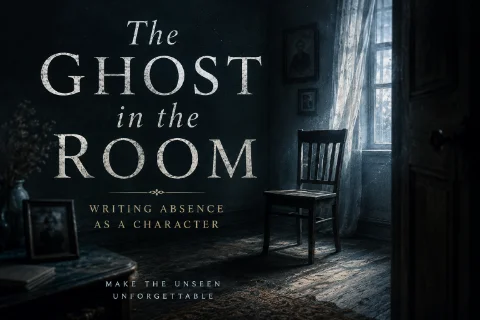
The ghost in the room does not always rattle chains.
Sometimes it is a name removed from conversation.
Sometimes it is a chair pushed too neatly under the table.
Sometimes it is a door everyone passes but no one opens.
Sometimes it is a person who left so completely that every remaining life bent around the empty space.
Writing absence as a character means understanding that what is gone can still act. It can guide, wound, protect, accuse, inspire, and haunt. It can become the invisible hand inside the story.
The missing can be louder than the present.
The empty room can hold the whole novel.
And sometimes, the most unforgettable character is the one who never appears at all.