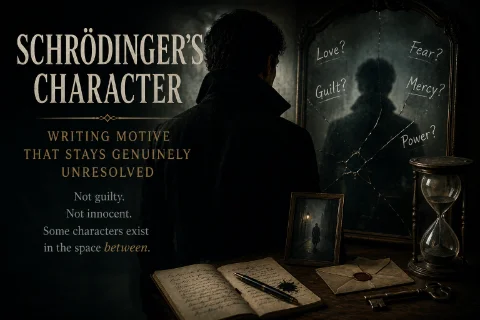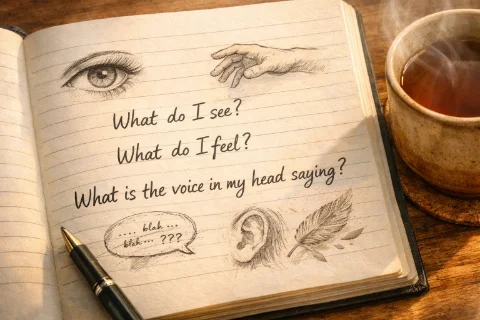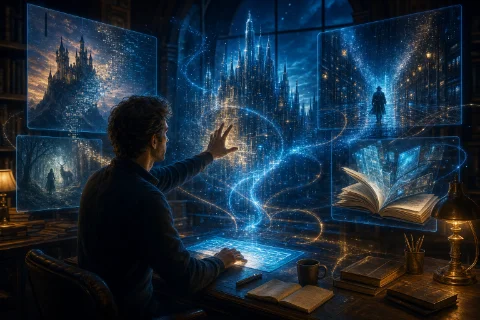
Stories have always lived at the edge of what humans imagine possible. Right now, that edge is moving faster than most writers feel ready for. AI writing assistants are reshaping the first draft. Virtual worlds are becoming narrative settings as rich as any city or century. And dramatic writing, the art of tension and reversal, matters more than ever.
If you write fiction, drama, or screenplays, this moment is not a threat. It is an invitation.
How AI Writing Tools Are Changing the Craft
The first thing most writers fear when they hear "AI writing tools" is that the machine will do the job instead of them. That fear is understandable. It is also misplaced.
Tools like Sudowrite, ChatGPT, and Claude work best as fast, patient collaborators. They can generate a passage you then rewrite completely, or suggest five ways a scene might turn so you can pick the one that surprises you. They function like a brainstorming partner who never tires and never judges your bad ideas.
What they cannot do is care about your story the way you do.
What AI Writing Tools Do Well
Beat generation: Ask for ten different ways a confrontation scene could resolve, and you get ten rough options in seconds.
Tonal variation: Paste a paragraph and request rewrites at different emotional registers. This is useful for finding voice.
Block-breaking: When a scene refuses to move, AI can generate a rough draft version that gives you something to argue with.
What You Must Protect
Your specificity. The detail that only you would think to include, the character contradiction only you find interesting, the line of dialogue that sounds like no one else.
AI tools learn from the general. You write from the specific. That gap is where your voice lives.
Writing in Virtual Worlds: A New Frontier for Story
Virtual world storytelling is no longer science fiction. Games like Red Dead Redemption 2 and Cyberpunk 2077 have proven that players will invest deeply in authored narratives inside digital environments. The metaverse is still becoming a place where people socialize, create, and tell stories.
What does it feel like to fall in love inside a persistent online world? What happens when a character's digital identity becomes more real than their physical one? What grief do you carry when a virtual world shuts down? These are deeply human questions.
Story Angles That Work in Virtual World Settings
The double life: A character who is timid offline but commands authority in a virtual community. The tension comes from which version is the "real" person.
The collapse: What happens when the server goes down, or the company behind the world sells? Loss inside a virtual world is still loss.
The body question: In a world where you choose your appearance, identity becomes a choice. That is rich territory for character work.
The bleed: When events in a virtual world start affecting the physical one, and the boundary between them stops being clear.
Writers setting stories inside virtual environments benefit from thinking in systems. A virtual world has rules, economies, and hierarchies; understanding those mechanics makes the world feel earned.
Advanced Dramatic Writing Techniques for Immersive Stories
Dramatic writing does not change just because your setting is digital. The architecture of tension, the mechanics of reversal, and the weight of a well-placed reveal are as essential in a VR narrative as they are on stage or in a literary novel. Here is what separates competent dramatic writing from the kind that makes readers miss their stops on the subway.
Stakes Escalation
Stakes are not just about danger. They are about what the character stands to lose that they cannot afford to lose. At the scene level, escalation means every beat should make the character's position more precarious or more exposed than the beat before.
In virtual world fiction, stakes operate on two levels: what is happening in the digital environment and what it costs in the physical one. A character might lose a virtual object that represents years of labor. That loss matters only if you have established what the labor cost them in the real world first.
Dramatic Irony
Dramatic irony occurs when the audience knows something a character does not. In virtual world narratives, this gets a structural upgrade: readers can know the NPC a character trusts is actually a human actor, or that the "game" the character is inside is not a game at all. Used well, this creates a sustained low hum of dread that keeps readers turning pages even when surface events seem quiet.
Scene Reversals
Every scene should end differently than it began, in terms of power, knowledge, or emotional position. A character who enters confident should leave uncertain. A character who enters afraid should leave with something, even if that is just a sharper understanding of the danger. Reversal is not a twist. It is the engine of every scene.
Tension Architecture
Think of your story's tension as a structure with load-bearing walls. Some scenes hold weight; others release it briefly before reloading. Map it as a rhythm: escalate, hold, briefly breathe, escalate further. The "breathe" scenes are where readers bond with characters, which makes the next escalation matter more.
Keeping Your Authentic Voice When Technology Is Everywhere
The risk in adopting new tools is not that they will replace your voice. It is that you will stop listening for it.
When you use AI-generated text with minimal revision, you borrow an averaged voice assembled from millions of texts. That voice reads slightly off to attentive readers, the way a stock photo reads slightly off in a personal album. The fix: treat AI-generated text as raw material, not finished work. Rewrite every generated passage in your own syntax and rhythm.
A Practical Workflow for AI-Assisted Drafting
Write your own rough version of a scene first, even if it is terrible.
Generate an AI version of the same scene for comparison.
Identify what each version does that the other does not.
Write a third version that sounds entirely like you.
This process is slower than using AI output directly. It is also the process that builds craft.
The Future of Storytelling: Interactive Fiction and VR
Interactive fiction is already well established, from classic text adventures to modern platforms like Inkle and Twine. AI-driven narrative engines can now respond to player choices with generated text that maintains tone and continuity across long branches.
Branching narratives are a philosophical statement: a character's choices matter enough to change the outcome. Writing them requires you to hold multiple versions of a story simultaneously, ensuring each branch feels inevitable.
VR storytelling adds a spatial dimension. The reader is not outside the story looking in. A revelation delivered by having the viewer turn and see something unexpected hits differently than the same information in prose.
Writers who want to work in these forms should learn them by doing. Write a Twine story. Spend time inside a richly authored game world and study the choices the writers made at each scene.
Practical Advice for Indie Authors and Dramatists
Start with one tool, not five. Pick one AI writing assistant, learn what it does well, and only add more when you have a clear gap.
Write your virtual world's rules before you write its story. What can be bought, sold, or lost? What happens when someone dies? Consistency earns reader trust.
Study dramatic structure in the forms you want to write. If interactive fiction interests you, read the Interactive Fiction Database. If VR narrative interests you, watch talks from narrative designers at major studios.
Finish things. The biggest risk of having infinite generative tools is that starting becomes easier than finishing. Completing a story, even a flawed one, is the most important thing you can do for your craft.
FAQ: Writing, Technology, and Virtual World Storytelling
Q: Do I need technical knowledge to write fiction set in virtual worlds?
A: No. You need curiosity and a willingness to research. Focus on the human experiences inside those spaces, not the code underneath.
Q: Will AI writing tools hurt my long-term writing craft?
A: They can, if you use them to avoid writing. Used as thinking partners and revision tools, they can accelerate skill development. The discipline is yours to maintain.
Q: What is the most important dramatic writing technique to master first?
A: Scene reversal. If every scene ends differently than it begins in terms of power or knowledge, your storytelling will feel alive even before you master everything else.
Q: How long does a branching narrative take to write compared to a linear story?
A: Significantly longer. Budget at least double the time of an equivalent linear piece, and outline all branches before you draft any of them.
Q: Is the metaverse a viable setting for serious literary fiction?
A: Yes. It raises questions about identity, community, loss, and what counts as real experience. Those are exactly the questions serious fiction exists to explore.
Q: How do I keep my voice consistent when writing across different formats?
A: Focus on what does not change: your recurring preoccupations, your instinct for character contradiction, and the scenes you find most interesting. Voice is less about style and more about what you keep noticing.
Write the Story Only You Can Tell, in Whatever World It Lives In
The technology is new. The human need for story is not.
AI writing tools, virtual world settings, and immersive narrative forms are not replacing the craft of fiction writing. They are expanding where stories can live and how readers experience them. The writers who will do this well are the ones who learn the new tools without forgetting why they started writing in the first place.
Pick up the tools. Study the techniques. Build the world. Then write the story only you would think to tell inside it.
If you are an indie author or dramatist ready to start, the best move is the oldest one: open a document and write the first scene. Let everything else follow from there.